
The AI revolution is real, but markets may have priced a perfect future into model vendors and infrastructure. OpenAI and Anthropic’s eventual listings will put revenue growth, margins, cash burn, and capital intensity under quarterly scrutiny. A merely good report could disappoint expectations, tighten model financing, and reverse demand across cloud platforms, data centres, chips, memory, networking, cooling, and power. The washout would not end AI: it would leave infrastructure and adoption behind, creating a healthier next cycle led by durable cash flow and competitively advantaged companies.
AI is a genuine technological revolution. That has never stopped capital markets from building a bubble around a real technology. Often, the more important the technology and the more exciting its future, the easier it becomes to pull a decade of prosperity forward and price it today.
That is why I have long believed that a bubble in this AI cycle was almost inevitable. The questions are when it breaks and where the break begins.
If I had to venture a prediction, one milestone worth watching would be the moment OpenAI and Anthropic truly enter the public markets. Anthropic and OpenAI confidentially submitted draft S-1 registration statements in June 2026, bringing both companies closer to a possible listing than ever before.[1][2] I am not saying that AI stocks will collapse on the day either company lists. Markets rarely follow such tidy scripts. The interesting point is that once the most important model companies move from private to public markets, the way investors judge them will begin to change.
The technology is real. Price is a separate question.
The original reason the AI trade took off was simple: large models were genuinely astonishing. ChatGPT gave ordinary people their first direct sense of what generative AI could do. Coding, reasoning, multimodality, and agents followed one step at a time, rapidly expanding our sense of what might happen to productivity. The technology is real. The demand is real. I still believe AI will become one of the most important foundational technologies of the next several decades.
But an industry’s capacity to change the world and the price of the companies inside it are two entirely different questions.
Markets can easily move from “AI will change the world” to “model vendors will earn extraordinary profits,” then to “cloud providers will keep raising capital expenditure,” and finally to “demand for GPUs, servers, memory, optical modules, liquid cooling, power equipment, and even copper can keep rising at today’s slope for years.” Each step sounds plausible on its own. Joined together, however, they can turn a sensible long-term trend into an implausibly perfect short-term assumption.
An arms race no one dares to leave
In an earlier essay, In the AI Gold Rush, I Would Rather Own the Shovels, I wrote that I did not doubt the importance of the model companies, but remained cautious about their long-term certainty as investments.
In the AI Gold Rush, I Would Rather Own the Shovels
Whoever wins the model race will still need chips, power, memory, networks, and data centres. Yet owning the shovels solves uncertainty about the winner—not uncertainty about the capital cycle.
Further reading · Investment research · July 2026
The industry’s central problem is not a lack of revenue. It is the extraordinary cost of remaining at the frontier. Today’s best model may not still be the best a few months from now. To stay in the first rank, every company must keep buying compute, hiring the world’s most expensive talent, training the next model, and then spending still more to serve that model to a growing number of users.
It resembles an arms race in which no participant dares to stop first.
OpenAI is a useful example. Internal documents obtained by The Information and reported by Reuters showed roughly $5.7 billion of revenue in the first quarter of 2026 and about $3.7 billion of cash burn over the same period.[3] Quarterly revenue of $5.7 billion is hardly weak. On the contrary, it describes a company growing at a remarkable pace. The more important questions are how much it costs to produce that revenue, and how much more capital will be required to keep it growing quickly.
A good report can still puncture a valuation
So I would restate my opening argument carefully. I am not claiming that OpenAI or Anthropic will report “bad numbers” after they list. Their results may look excellent, and revenue may continue to grow very rapidly. What could puncture the valuation is a report that looks good, but not nearly good enough to support everything the market had already imagined.
Capital markets do not really trade good against bad. They trade the distance between reality and expectations.
Private markets can spend years discussing ARR, user growth, model capability, AGI, and the size of the market several years from now. Public investors will discuss those things too. But every three months, the conversation eventually returns to less glamorous numbers: gross margin, free cash flow, the amount of capital required to add one dollar of revenue, when that investment can begin to fall, and how much profit will ultimately remain for shareholders.

Intelligence is getting cheaper
Those questions become even more important as large models themselves grow cheaper.
Chinese model developers are adding to the pressure on prices. Citing data from Artificial Analysis, Reuters reported that DeepSeek’s latest V4-Flash had a benchmark running cost less than one-hundredth that of Anthropic’s Claude Fable 5.[4] Token prices alone cannot determine a model’s commercial value. The final increment of capability in a frontier model may still matter enormously for coding, research, and other high-value work. Yet for a large share of consumer and enterprise tasks, the competitive question may gradually shift from “Who has the smartest model in the world?” to “Who can provide intelligence that is good enough at the lowest cost?”
That would be excellent for AI adoption, but not necessarily for model-company margins. A technology can create immense value for society without allowing its creators to retain all that value on their own income statements. The internet is worth far more to society than the combined profits of internet companies. Electricity’s importance to modern life cannot be measured simply by the market value of utilities. AI may ultimately be no different.
The industry has already bet real capital on an optimistic future
If markets begin reassessing the economics of model companies, the consequences will not stop with the model companies. AI has already created an enormous capital-spending chain. Model vendors buy compute. Cloud providers build data centres. The data centres buy GPUs, servers, memory, and networking equipment, while pulling further demand through liquid cooling, power supplies, grids, and energy. I still believe this chain contains investments that may prove excellent over the next decade. But we should also admit that much of today’s demand has been pulled forward by expectations of tomorrow’s demand.
A Reuters analysis of LSEG data produced a striking estimate. By 2027, Microsoft, Alphabet, Amazon, Meta, and Oracle were expected to add roughly $534 billion of capital expenditure while adding only about $340 billion of operating cash flow—around $1.57 of incremental investment for each additional dollar of operating cash flow.[5] By August 2026, the same companies had accumulated roughly $1.09 trillion of future payment commitments on leases that had not yet commenced, a substantial share of them tied to AI data centres.[6]
Those figures do not prove that AI infrastructure has already been overbuilt. If demand continues to exceed expectations, investments that look aggressive today may appear entirely sensible in a few years. They do establish one thing: the industry has placed a very large bet, in real capital, on a highly optimistic future.
During the ascent, this structure creates a powerful positive-feedback loop. Better models and more usage make investors more willing to fund model companies. The companies spend that money on compute, raising cloud revenue and encouraging more data-centre construction. Upstream suppliers receive more orders, their shares rise, and the market treats those rising shares as further evidence of strong AI demand. More capital then enters the cycle.
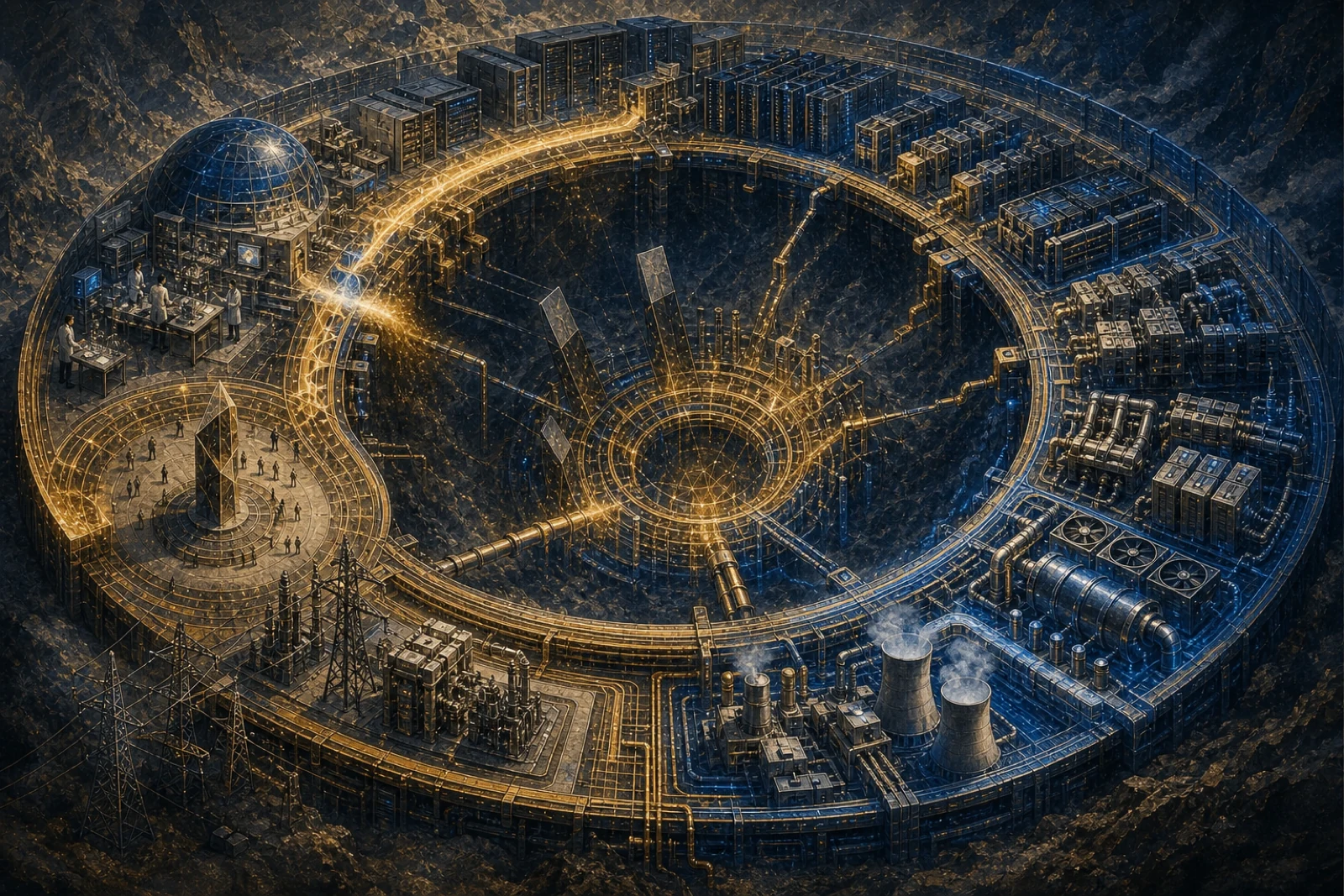
Reflexivity works on the way down too
The problem is that reflexivity does not operate in only one direction.
Imagine that public results from OpenAI, Anthropic, or another model company show investors that large models can indeed produce remarkable revenue, but at lower margins and with more persistent cash burn than expected. Valuations come under pressure first. Financing costs rise next. Model vendors become more cautious about buying compute. Cloud providers discover that customer demand for the next several years is less aggressive than their earlier forecasts and revisit their capital budgets. The effect then travels back through servers, memory, optical networking, liquid cooling, and power equipment.
None of those businesses needs to enter an outright recession. A sector priced for 30% growth can fall sharply when growth proves to be 20%. An industry expected to remain undersupplied for three years can be repriced quickly when supply and demand look likely to balance in year two.
The shovel sellers have a capital cycle too
This is the other side of the “shovel” thesis from my previous essay. I still prefer searching for things every AI participant must buy, because that reduces the need to identify the eventual model winner. But selling shovels solves uncertainty about the winner; it does not solve the capital cycle. If every prospector suddenly finds financing harder to obtain and buys fewer shovels for a while, the shovel seller’s orders will decline too.
If that day comes, however, I will not necessarily regard it with pessimism.
After the washout, the infrastructure remains
Technological revolutions often arrive with this seemingly absurd waste of capital. Excessive optimism attracts money. Infrastructure is built ahead of schedule. Capacity races far in front of demand for a period. The bubble then breaks and investors suffer severe losses. Yet something interesting happens: the share prices disappear, while much of the infrastructure remains.
The internet bubble is a classic example. Looking back at the investment cycle of the late 1990s, the Federal Reserve Bank of New York concluded that excessive optimism about profits from new technologies—especially in communications—helped drive an unsustainable surge in investment that contributed to the turn from boom to bust.[7] Investors paid dearly for overbuilt fibre and communications networks. Those networks did not vanish underground when the Nasdaq fell. The best internet companies that followed grew in a world with lower costs and more mature infrastructure.
AI may pass through a similar cycle.
The data centres, grids, servers, storage capacity, optical networks, and energy infrastructure being built around the world do not become worthless merely because some of them prove to have been built too early or in excessive quantity. What a broken bubble usually destroys is not the technology, but inflated asset prices, unrealistic growth expectations, and business models that survived only through a constant supply of capital.
From that perspective, a genuine washout might eventually make the AI industry healthier. Capital would stop awarding extraordinary valuations to every project carrying an AI label. Model companies would calculate costs and profits seriously. Cloud providers would revisit each capital-spending decision. Upstream suppliers would stop expanding without limit simply because the market was temporarily undersupplied. Weak participants would leave, and companies with real technological barriers, cost advantages, resilient balance sheets, and durable demand would become easier to identify.
The next rally must run on cash flow
For investors, that may be a more comfortable environment than today’s.
I do not look forward to the bubble breaking for its own sake, and I would not try to call the top and short the market merely because I believe a bubble exists. Markets can remain irrational far longer than a position can remain solvent. But if a future panic throws away excellent assets alongside the rubbish, I will be very willing to revisit companies I have long wanted to own at prices that never made sense before.
A 50% decline does not automatically make an asset cheap. What interests me is the point at which markets no longer assume that AI capital expenditure will grow forever at today’s rate; expectations have been revised down thoroughly; excess capacity has begun to clear; and yet real AI usage, model capability, and penetration of the physical economy continue to increase.
If some companies still possess irreplaceable technology, cost advantages, scarce resources, and healthy balance sheets at that point, I may be far more willing to own them heavily than I am today.
I have never considered “AI is a bubble” and “AI will change the world” to be contradictory conclusions. The technological revolution can be real, and so can the bubble. Indeed, the size of the future is precisely what makes people willing to overpay for it in the present.
The eventual listings of OpenAI and Anthropic may simply bring this revolution under the lights of the public market for the first time. There, investors will no longer be limited to discussing how much smarter the models have become. They will be able to see how much capital is required to manufacture that intelligence—and how much cash is left at the end.
If the answer is less perfect than today’s market imagines, the tide will eventually go out. I do not believe that will mark the end of the AI story.
The data centres, power systems, chips, networks, talent, and habits created during the first boom will still exist. They will lower the costs of the companies that follow and form the foundation of the next cycle. Once markets stop paying an unlimited price for imagination, the businesses capable of producing real cash flow will matter much more.
AI may feel less exhilarating by then.
But the next rally may be healthier and more durable.
The first rally runs on our imagination of the future.
The next should run on that future becoming real.
Sources
- OpenAI: Confidential submission of draft S-1 to the SEC, 8 June 2026.
- Anthropic: Anthropic confidentially submits draft S-1 to the SEC, 1 June 2026.
- Reuters: OpenAI burned $3.7 billion in first quarter of 2026, The Information reports, 16 June 2026.
- Reuters: DeepSeek’s new AI model is by far the cheapest of well-known models to run, research firm says, 3 August 2026.
- Reuters: AI investment boom puts Big Tech’s free cash flow under pressure, 22 July 2026.
- Reuters: AI data-centre race builds $1 trillion lease burden for Big Tech, 4 August 2026.
- Federal Reserve Bank of New York: What Investment Patterns across Equipment and Industries Tell Us about the Recent Investment Boom and Bust, 18 May 2004.
This essay is a personal view of an industry and capital cycle, not investment advice.



ABOUT THIS ESSAY
Leave a thought. 00
Discussing: When the AI Story Meets the Financials
Different perspectives are welcome. Be kind. Both language versions of this essay share this conversation.
No published comments yet. Your thought could be the beginning of a conversation.