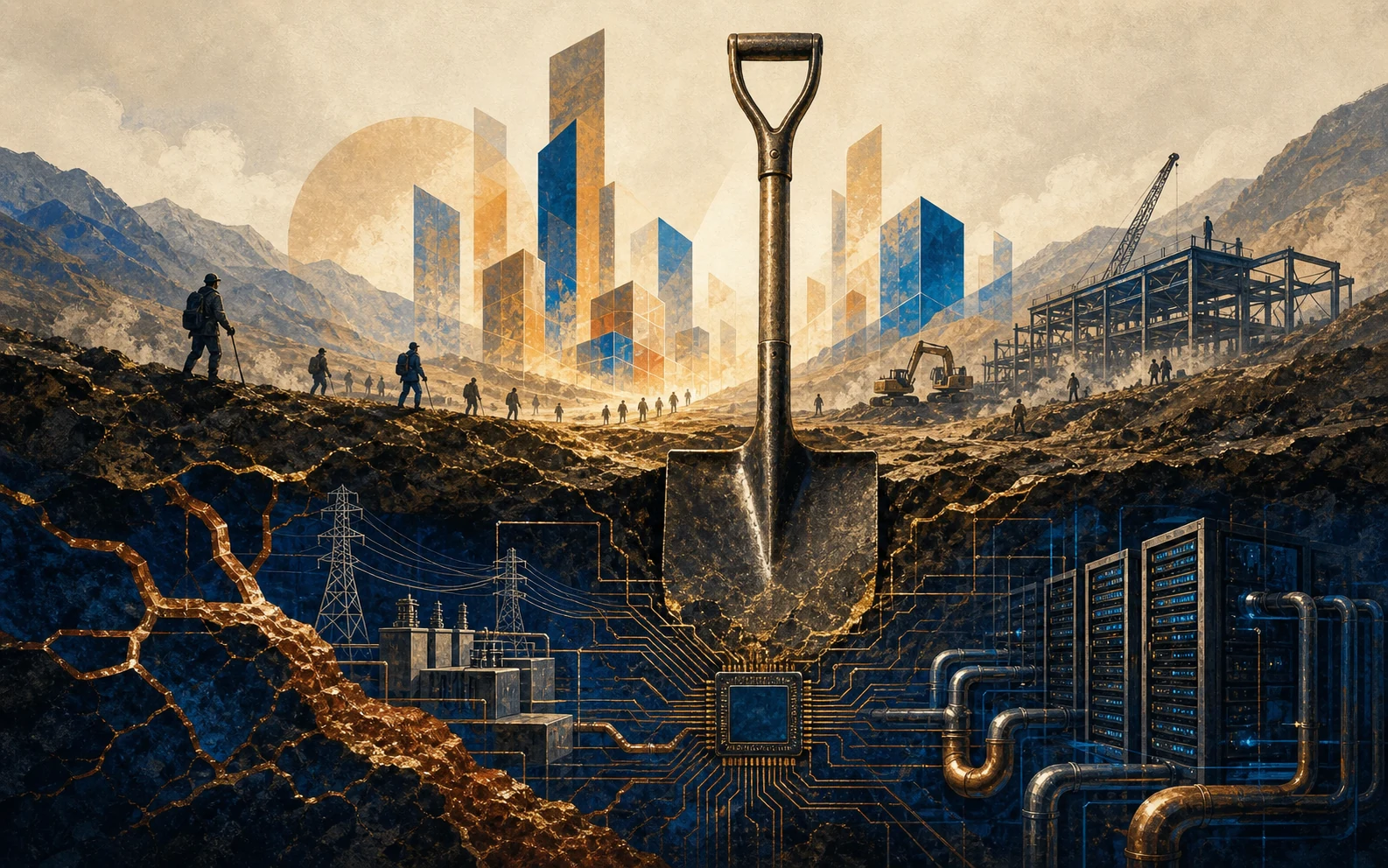
After discussing AI investing with his father, the author favours researching infrastructure that every model developer needs. Model leadership can be fleeting and expensive, while many users prioritise value over frontier performance. Chips, energy, materials and cooling may benefit from shared demand, but infrastructure still carries valuation and overcapacity risks. Competitive advantages, costs and expansion discipline remain essential.
This line of thought emerged from a recent conversation with my father.
We were discussing where the most durable investment opportunities in artificial intelligence might ultimately lie. The obvious answer seemed to be the companies building the most advanced models. They occupy the centre of attention, attract the greatest concentration of capital and talent, and appear closest to the frontier of technological progress.
Yet the longer we talked, the less convinced we became that the most important companies of the AI era would necessarily make the best investments.
I have long believed that large-language-model companies may become some of the most consequential businesses of our time. Yet that does not necessarily make them the best businesses to own—or the kind of investments in which I would be comfortable placing a concentrated bet.
The problem is not that large language models lack value. Quite the opposite: AI may eventually become as pervasive as electricity or the internet, embedded in nearly every industry and underlying much of the world’s knowledge work.
But an industry can transform the world without allowing its most visible participants to capture an equally extraordinary share of the economic value it creates. Investors are not rewarded simply because a technology is revolutionary. What matters is whether a company can build a durable moat, preserve pricing power, and convert technological progress into sustainable profits.
At present, the greatest weakness of the large-model industry is that technological leadership appears remarkably fragile.
One company may release the world’s most capable model today, only to be overtaken several months later by a rival with more computing power, better data, a stronger research team, or a more efficient training method. The leading position changes constantly, while the underlying technological architecture has yet to fully stabilise.
Being described as the maker of the “best model in the world” may therefore represent a temporary advantage rather than a lasting monopoly.
This creates an unforgiving competitive structure. Model developers must continue spending enormous sums merely to remain in the first tier. If they slow their investment in research, infrastructure, or talent, their apparent lead may disappear almost immediately.
That does not resemble a conventional economic moat. It looks more like an arms race in which every participant must continue spending simply to avoid falling behind, while none can be certain that today’s investment will secure tomorrow’s leadership.

More importantly, most users do not actually need the most advanced model available.
Suppose the best model in the world offers a capability level of 100. A much cheaper, second-tier model may already deliver 80 or 90. For frontier scientific research, advanced mathematics, complex software engineering, or high-value professional decisions, the remaining ten or twenty points may matter enormously.
For the average user, however, they often do not.
Writing emails, translating documents, summarising information, preparing spreadsheets, generating marketing copy, answering routine questions, and assisting with everyday office work rarely require the absolute frontier of machine intelligence. In these situations, a model that is merely “good enough” can satisfy nearly all of the user’s practical needs.
A consumer does not pay several times more for a car simply because its top speed is 350 kilometres per hour. On ordinary roads, that extra performance has little practical value. The same logic may apply to AI. Most users cannot fully exploit the capabilities of the most advanced models, so their purchasing decisions may ultimately depend less on benchmark rankings and more on price, speed, reliability, convenience, and integration with existing workflows.
This is where Chinese AI companies may possess a meaningful advantage.
They may not need to lead the world on every technical benchmark. If they can provide near-frontier capabilities at a fraction of the price, they could capture a vast market among consumers and businesses for whom value for money matters more than absolute performance.
For many customers, the improvement from a model scoring 90 to one scoring 95 may not justify a twofold or threefold increase in cost. A model that is slightly weaker but dramatically cheaper could therefore achieve far greater adoption.

This produces a counterintuitive possibility: the company with the most powerful model may not have the strongest business model. A technically inferior competitor may accumulate more users and more usage simply by offering a better balance between capability and cost.
Yet even winning through scale does not guarantee attractive economics.
As model performance converges and prices continue to fall, foundation models themselves may gradually become commoditised. A company can serve millions of users and still struggle to generate meaningful profits. Greater usage also means greater expenditure on chips, servers, data centres, electricity, and inference capacity.
Without differentiated applications, a powerful ecosystem, proprietary data, or deeply embedded enterprise relationships, scale may produce little more than a larger infrastructure bill.
For this reason, I am not necessarily bearish on large-model companies. I am simply reluctant to treat them as high-certainty investments merely because they occupy the centre of the AI revolution. Nor would I consider temporary leadership in model performance sufficient justification for a large, long-term position.
Instead, I am more interested in the companies selling the shovels in this new gold rush.
Regardless of which model developer eventually wins—and regardless of whether American companies dominate the frontier or Chinese companies expand through lower prices—the entire industry will require more semiconductors, memory, optical components, servers, data centres, cooling systems, and electricity.
Training models requires computing power. Computing power requires chips. Chips require advanced packaging, memory, and high-speed interconnects. Servers place greater demands on cooling systems. Data centres require power grids, transformers, natural gas, nuclear energy, copper, aluminium, and a wide range of other physical resources.
Model providers may replace one another, but their dependence on infrastructure is shared.

That is the real meaning of the gold-rush analogy. Prospectors compete against one another. Some discover gold; many lose everything. Yet as long as enough people rush towards the mines, there will be genuine demand for shovels, transport, shelter, equipment, and infrastructure.
For an investor, it may therefore be more attractive to own the assets that every participant must purchase than to predict which individual model will ultimately prevail.
Of course, selling shovels is not automatically safe.
AI infrastructure can also become overvalued. Excessive enthusiasm can lead to duplicated investment, aggressive capacity expansion, and eventual oversupply. Once the market recognises a rising source of demand, capital floods into the industry. If the growth of AI-related expenditure begins to slow, the price of the shovels may fall as sharply as the fortunes of the prospectors.
The opportunity, therefore, is not to indiscriminately buy anything associated with AI infrastructure. It is to identify businesses with genuine scarcity, technological barriers, structural cost advantages, disciplined expansion, and limited supply.
Energy, copper, grid equipment, advanced packaging, high-speed optical interconnects, power management, and liquid cooling may offer greater long-term certainty than model developers locked in a perpetual contest for temporary technological leadership.
That, ultimately, was the conclusion my father and I reached in our conversation.
We were not denying the importance of the companies building the world’s most advanced models. Nor were we claiming that none of them could eventually become a dominant platform with a powerful and durable ecosystem.
Our conclusion was simply that, at this stage of the industry, it may be easier to see the growth of AI demand than to predict who will capture its profits.
The model companies are competing to define the future. The infrastructure companies are already being paid to build it.
Models shape the way we imagine that future. Energy, materials, chips, data centres, and physical infrastructure determine whether it can actually exist.
For now, I would rather invest in what nearly every possible winner will need than place a concentrated bet on which individual company will win.
After all, the prospectors are competing for gold they may never find.
The shovel sellers are being paid for a demand that already exists.



ABOUT THIS ESSAY
Leave a thought. 00
Discussing: In the AI Gold Rush, I Would Rather Own the Shovels
Different perspectives are welcome. Be kind. Both language versions of this essay share this conversation.
No published comments yet. Your thought could be the beginning of a conversation.