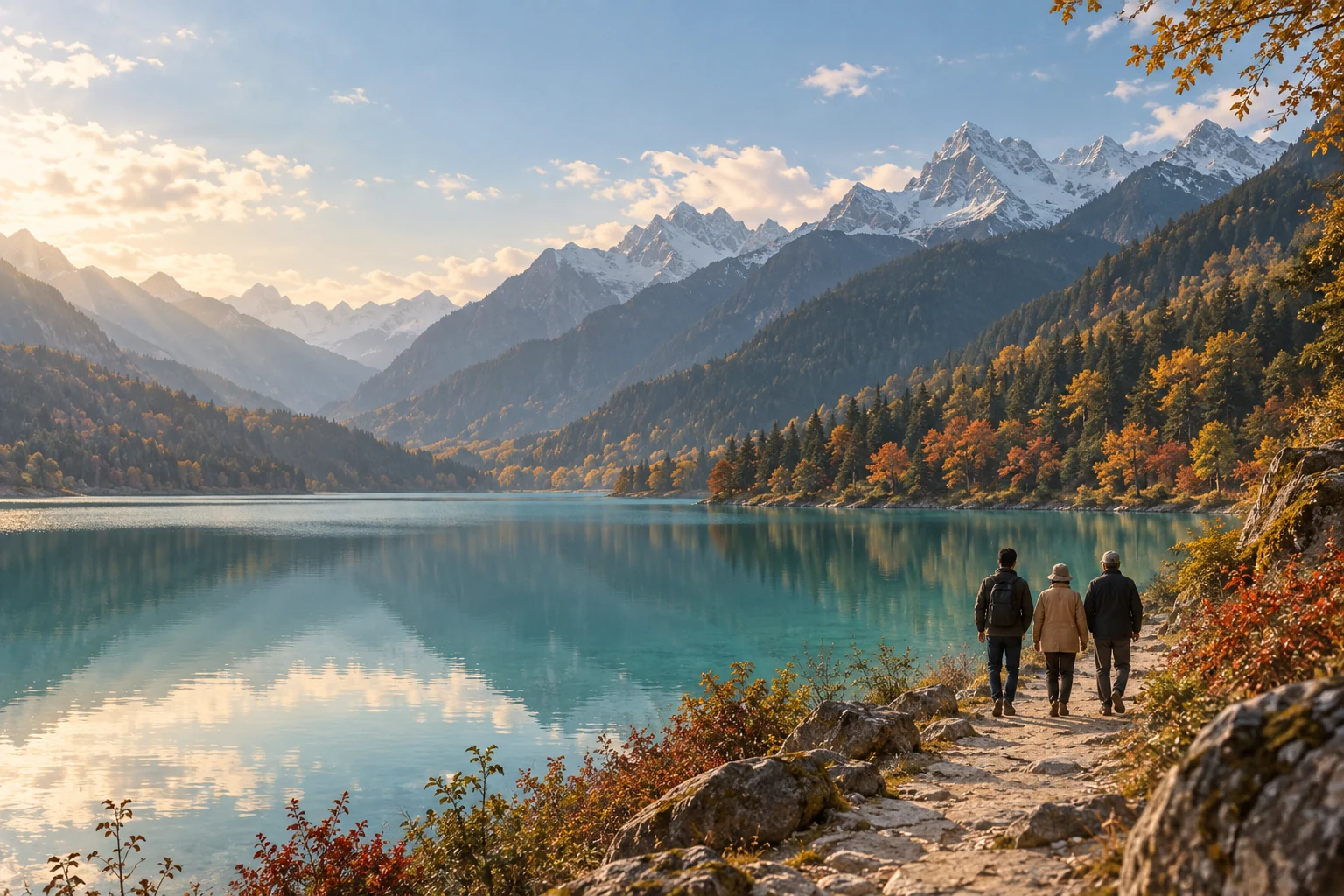
Before the Mid-Autumn Festival, the author takes a long-awaited family trip with his parents through Chengdu, Mount Qingcheng, Dujiangyan, and Jiuzhaigou. He remembers Chengdu’s easy pace, an unplanned hotpot meal, and the quieter atmosphere of Jiuzhaigou County more fondly than a rushed tour of famous sights. His parents’ modest habits also prompt a reflection on money: its value lies in the choices it makes possible, not in impressing strangers. The chance for a healthy family to travel together is finite, and freedom matters in part because it allows him to give time to the people he loves.
We’re going back to Sichuan to visit my grandmother for the Mid-Autumn Festival, so I spent the past few days exploring Chengdu and the surrounding area with my parents.
We went to Chengdu, Mount Qingcheng, and Dujiangyan, then continued on to Jiuzhaigou.
It feels rare, now that I think about it. This was probably the first proper trip the three of us have taken together in years. We weren’t there to take care of an errand, and we weren’t stopping somewhere on the way to somewhere else. We could simply walk around, eat together, and look at the scenery.
Chengdu: a city made for living
Chengdu has always felt comfortable to me.
The city is still lively well into the evening, with plenty going on after dark, but it doesn’t have the taut energy of some larger cities. Everywhere you look, people are eating, drinking tea, or talking by the roadside. No one seems to be in a hurry to get somewhere else.
There’s an ease to the way people live here.
The cost of living isn’t particularly high, and the food is wonderful. If I set aside work and the other practical considerations, Chengdu is genuinely appealing as a place to live.
Sometimes the question I ask myself about a place has little to do with how many famous sights it has:
Would I want to live here for a while?
Chengdu is somewhere I would.
Mount Qingcheng: Taoist temples, Buddhist temples, and the vegetarian meal we missed
After that, we went to Mount Qingcheng.
Its Taoist atmosphere is unmistakable. The buildings and the mountain setting make it feel quite different from an ordinary scenic area.
I also heard a story there for the first time.
Apparently, during the Tang dynasty, Taoists and Buddhists disputed territory on Mount Qingcheng, and the argument eventually reached the emperor. Roughly speaking, the outcome left Taoist temples higher up the mountain and a Buddhist temple below.
It is quite a scene to imagine: people in ancient times taking a dispute over religious land all the way to the emperor.
When we came down the mountain, we planned to have a vegetarian meal at Puzhao Temple.
I’d seen Nicholas Tse recommend it and thought we might as well give it a try.
But we arrived too late. The kitchen had stopped serving.
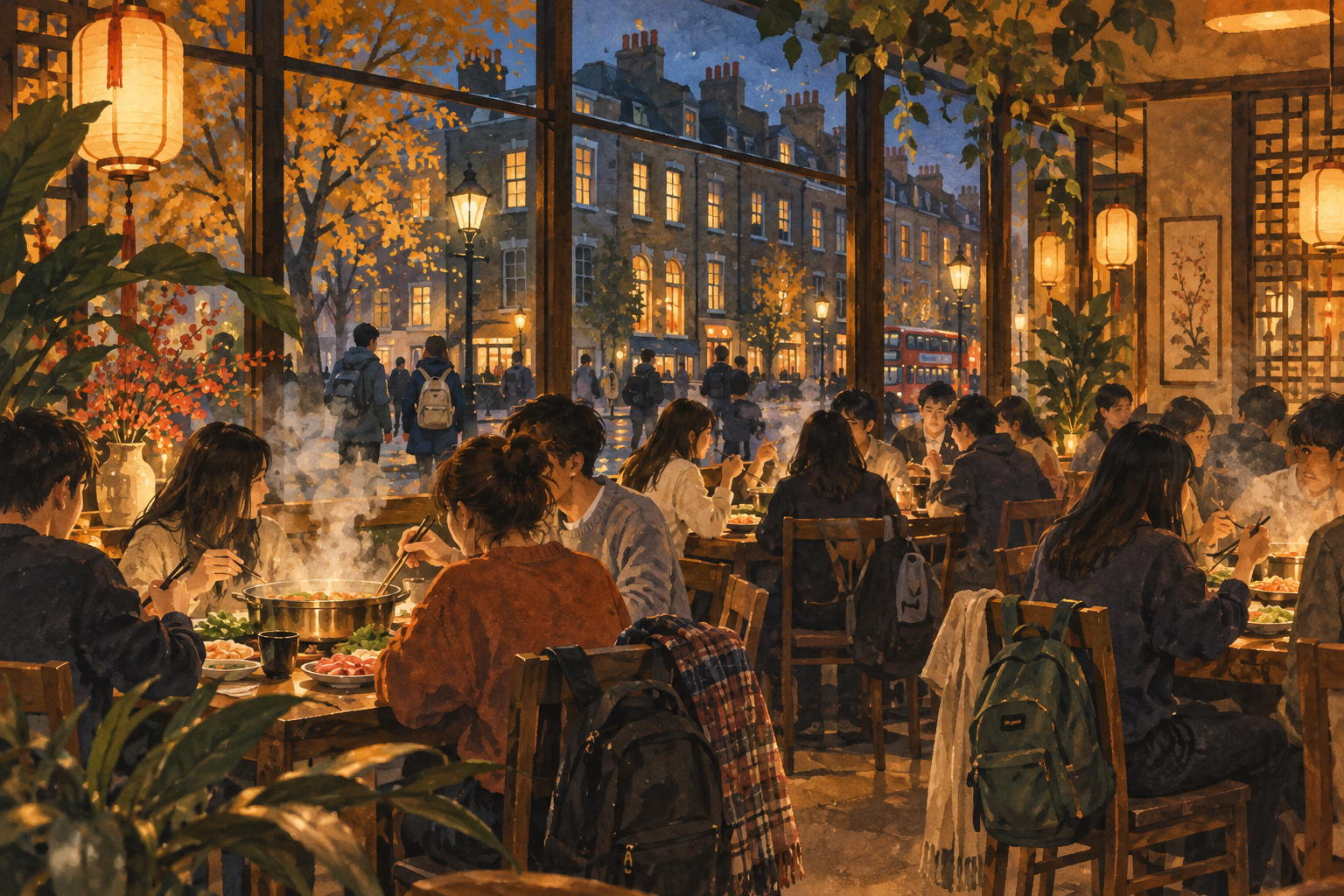
So we changed plans and found a hotpot restaurant with promising reviews. When we got there, the queue was enormous.
In the end, we went to another place nearby called Shijing Tu Hotpot.
We walked in with little more than a “well, we’re here now” attitude, but it turned out to be delicious and felt wonderfully local.
That’s how travel sometimes works.
You miss the meal you planned for, then wander into somewhere else and come away with one of the most memorable meals of the trip.
Jiuzhaigou, and how I learned Delta was a Marriott brand
Later, we went on to Jiuzhaigou.
Rather than staying near the scenic area, we chose a Delta hotel in Jiuzhaigou County. Delta doesn’t seem especially common in China; this was only my second stay with the brand.
There’s a funny story behind the first.
I stayed at a Delta in Toronto when I went there to celebrate Cassidy’s birthday. The name initially made me think it had something to do with Delta Air Lines. Only later did I learn it was a Marriott brand.
This stay was good, too.
The scenery around the hotel was lovely, and the service was attentive. Thanks to my Marriott status, our two rooms were upgraded to a suite and an executive room.
I actually preferred the atmosphere in the county town to the area around the entrance to Jiuzhaigou.
There were fewer tourists and less crowding. It felt closer to the rhythms of local life. The local people we met along the way struck me as unpretentious and straightforward.
Our driver told us something interesting as well.
According to him, some of Jiuzhaigou’s original residents now receive substantial annual dividends from the scenic area and can live quite comfortably on them.
Meanwhile, people who studied or worked hard to leave the mountains years ago may no longer qualify for those benefits precisely because they left.
I kept thinking about that.
It can be remarkably difficult to predict how times will change.
A place people once struggled to leave can become an asset through tourism, while those who managed to make their own way out may miss the rewards it later brings.
Life has its ironies.
Jiuzhaigou is beautiful, but scenic areas still aren’t my thing
Jiuzhaigou is beautiful, of course.
There’s no denying that.
The lakes are intensely blue, the mountains are lovely, and the natural setting has something distinctive about it.
But perhaps this is just me: after seeing them one after another, I began to find many of the lakes somewhat similar.
The first blue lake is breathtaking. By the second, third, and fourth, a little visual fatigue starts to set in.
I enjoyed the stretch through the old-growth forest much more.
It didn’t feel quite so much like a “sight.” Walking among the trees, I felt much quieter.
Then we reached the famous Five-Color Pond, which left me a little underwhelmed.
Perhaps my expectations had been raised too high. My first thought when I saw it was:
Where are the five colors?
I’ve never been particularly drawn to trips built around visiting attractions.
Many popular scenic areas in China are especially crowded.
However beautiful the view, it can lose its charm when you are constantly surrounded by dense crowds, with everyone queuing, taking photos, and rushing on to the next stop.
This trip confirmed something for me:
What I really enjoy about travel may have little to do with ticking off one famous attraction after another.
I would rather find a comfortable hotel in a place whose scenery can hold its own against any scenic area.
No tight itinerary, and no need to squeeze through a crowd of thousands.
Wake up when I’m ready. Have breakfast, look at the mountains, drink something. If I feel like going out, take a drive; if not, stay at the hotel.
Enough space, and enough privacy.
That sort of holiday suits me far better.
Travel isn’t a task to complete.
If the whole point is to rest, why make yourself more tired than you were at home?
Traveling with my parents made me think about something else
There was another thought that stayed with me throughout the trip.
Honestly, my parents may be the most modest people I know among those in a similar financial position.
Luxury goods hold almost no interest for them.
Some people begin earning a little more and immediately start buying things, sometimes spending everything they make in a month on bags, watches, cars, and clothes, as though those purchases must prove their lives have changed.
My parents have never seemed to feel that need.
I might not have given it much thought before.
But after spending the past few years investing, trading, and earning money myself, I’ve slowly begun to understand them.
What, in the end, is money for?
It sounds like a simple question. I suspect many people never seriously ask it.
If the sole purpose of making money is to convince strangers that you have it, the whole exercise seems rather absurd.
If you buy a watch because you love that watch, buy it.
If you stay in a good hotel because you feel comfortable there, stay.
A more comfortable car, better food, a trip somewhere you want to go: these choices should be about your own experience.
They shouldn’t be about posting a photo so that someone else thinks, “Look how well that person is doing.”
Whether strangers think I have money means nothing to me.
I have no need to prove it to people who have no place in my life.
If the number in my account is growing, it is enough that I know it.
I want to have choices when I need to spend money, and no need to spend it when there is nothing I want.
To me, that may be the most meaningful thing money can offer:
It buys choices, not things.
The choice to go somewhere when you want to.
To rest when you need to.
To handle a family matter without worrying about the cost.
To share an experience with someone you love.
Perhaps most importantly, to have time that is your own.
Once you’ve earned the money, who gets your time?
After this trip, I feel I should take my parents away more often.
I used to think we could travel whenever we liked. There would always be time later.
But when I really think about it, many things are not limitless.
I can earn more money later. Projects can continue, and there will always be opportunities in the market.
But for a family to be healthy, free at the same time, and able to travel together—that window does not stay open forever.
The life I have chosen already gives me more freedom than most conventional jobs do.
I don’t have to sit in an office at fixed hours every day or arrange my life around a dozen or so days of annual leave.
That freedom should mean more than being able to go wherever I want on my own.
It also means I can make more time for the people who truly matter to me.
I used to think of “financial freedom” quite naturally as having choices for myself.
Now I see another side of it:
At last, you can give some of your time to the people you love.
Nothing extraordinary happened over these past few days.
We ate, climbed a mountain, sat in cars, admired the scenery, slept at the hotel, and talked now and then.
Looking back, those ordinary days feel all the better for being ordinary.
There was nothing to prove and no grand goal to accomplish.
My parents were happy. I was happy.
That was enough.
We should get away together more often.
And this Sichuan trip isn’t over yet.
After Jiuzhaigou, we went on to Grandma’s home in Shiqiao, Dazhou. The journey continues in Sichuan, Part II: Back to Shiqiao, Back Home.
很好的分享,评论设置在每篇文章后面就更好了