
The author has long liked Meta's smart glasses but worried about its model quality. Muse and Tencent's WorkBuddy suggest another possibility: distribution through glasses, social relationships, and workflows could outlast any single model lead. Models may be replaceable; habits and networks are harder to move. He still favours AI infrastructure, sees Meta as a long-term candidate at the right price, and has begun building a Tencent position. These are personal judgments, not guarantees of model performance or investment returns.
I have long had a conflicted view of Meta.
On one hand, I have always thought it was unusually far ahead in smart glasses.
Using Meta Ray-Ban Display has only strengthened that view. Until a genuinely mature brain-computer interface arrives, I suspect glasses will gradually take over a meaningful share of what we now do on smartphones.
The reason is simple: phones are extraordinarily capable, but they are not always a natural way to interact with the world.
Sometimes I see something worth photographing and cannot be bothered to take my phone out of my pocket. Sometimes I want one small piece of information and do not want to look down at a screen. If my glasses can handle those moments, the whole experience becomes lighter.
Photos, video, directions, notifications, translation, calls, and AI voice interaction do not inherently require a screen that I hold in my hand.
Meta keeps moving in that direction. It has expanded hands-free navigation and calendar features on Meta Ray-Ban Display; mirrored phone notifications are among the features it says are still to come. It has also announced plans to bring its personal agent, Muse, to AI glasses, making the glasses another place from which people can ask it to act. Meta on Display features; Meta on Muse and glasses
To me, this could be one of AI’s most natural consumer interfaces.
If AI lives forever in a chat box inside an app, it remains a tool you must decide to open.
If it lives in your glasses, sees what you see, hears what you hear, and offers information through voice or a display when it is useful, it begins to feel like a companion that travels with you.
So I have been consistently optimistic about Meta’s hardware and its position at the point of interaction.
That is also where the contradiction begins.
On the other hand, I used to think Meta’s AI models lagged badly. Not just a little.
Judging only from my own experience over the past stretch, I struggled to put Meta AI in the first tier alongside OpenAI or Anthropic, or even Google, xAI, and many Chinese model makers.
That puzzled me. Meta ought to be one of the best-placed companies in the world to build AI. It has Facebook, Instagram, WhatsApp, Messenger, and Threads: an immense collection of social, content, and messaging surfaces. It also has cash flow, the ability to spend on compute, and exceptional talent.
In theory, it should be among the likeliest contenders at the frontier. Yet its models had long felt ordinary to me.
My old conclusion was straightforward: I loved the glasses and the distribution, but if the intelligence itself was weak, a company with a truly great model might eventually push Meta aside.
Recently, I began to wonder whether I had the problem backwards.
Meta does not need the world’s best model
Two things changed my thinking: Muse, and my recent experience with Tencent’s WorkBuddy.
Muse is intriguing. Meta is plainly trying to move AI beyond conversation and towards a personal agent. According to Meta, Muse can carry out multi-step tasks, use a browser and authorised apps, and return sensitive actions to the user for approval. Meta has announced that it will extend that agent to glasses. Meta’s Muse announcement
That made something click: perhaps Meta’s moat was never supposed to be, “We own the strongest model on Earth.” It might not need to win that race at all.
This fits the argument I made in “In the AI Gold Rush, I Would Rather Own the Shovels.” Most ordinary users do not need the world’s most capable model.
Imagine that the best model scores 100. A much cheaper and faster one that scores 85 or 90 may already be more than sufficient for most everyday tasks.
Email, translation, research, summaries, scheduling, replies, basic office work: in these situations, the difference between 90 and 95 may matter far less to most people than it does to those of us who use AI all day.
What matters more is whether AI is there when the user needs it.
The interface may be worth more than the model
Suppose the best model in the world belongs to OpenAI. But the ordinary person who wakes up every morning puts on Meta’s glasses, opens WhatsApp, scrolls Instagram, messages friends in Messenger, and reads Facebook and Threads.
Which company is more likely to become that person’s default AI? It may not be the one with the best model. It may be the one that controls the points of interaction.
Most users will never ask whether the model behind a task is ranked first or fifth. They will ask whether they can say one sentence and get the thing done.
That is what stood out to me when I used Tencent’s WorkBuddy. It is not locked to Tencent’s own models. Tencent’s documentation lists choices including Hunyuan, Kimi, and DeepSeek, and describes connections to workplace messaging, documents, email, meetings, and knowledge tools. Tencent Cloud on model selection; Tencent Cloud on WorkBuddy
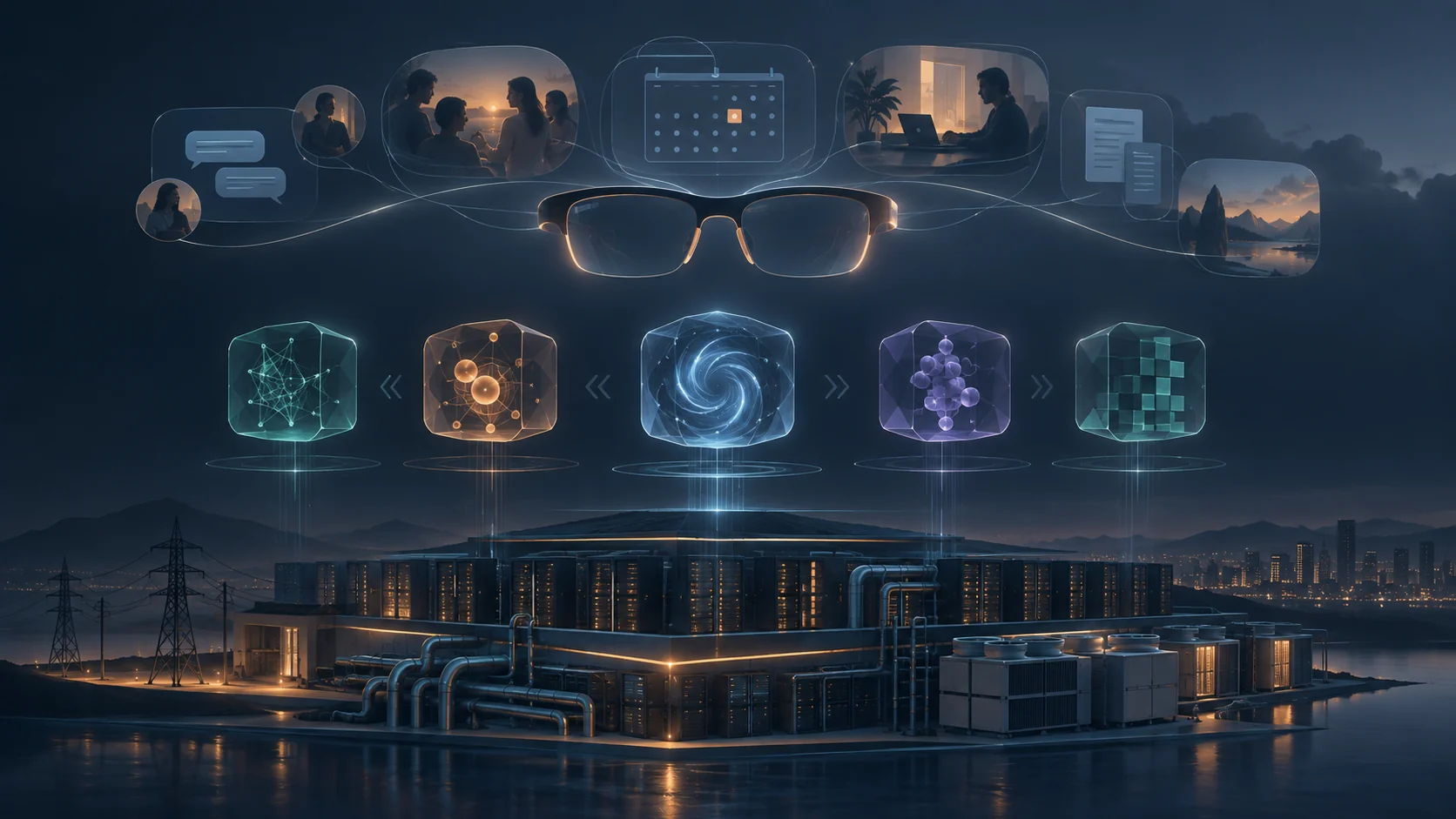
It suggests a fascinating business model: the model can be a supplier.
If DeepSeek is better today, use DeepSeek. If Kimi is better tomorrow, switch to Kimi. If OpenAI or another provider offers a better fit later, it can be integrated if the technical and commercial terms work.
The underlying model can change. The user’s files, conversations, workflows, Enterprise WeChat relationships, tools, Skills, agent memory, and habit of opening WorkBuddy each day remain with Tencent.
Who owns the customer relationship then? Not necessarily the model maker. The company at the interface may own it.
That may be Meta’s most formidable advantage
Apply the same logic to Meta, and the picture changes.
Meta has one of the world’s largest social platforms, one of its largest messaging networks, Instagram, WhatsApp, Facebook, Messenger, Threads, and an increasingly mature line of AI glasses.
In the past, these looked like separate products. In an agent era, they could become different senses and tools belonging to one AI system.
The glasses see the physical world. WhatsApp and Messenger handle conversations between people. Instagram and Facebook provide content and social context. Calendars, email, shopping, and outside services become tools an agent can use. Muse sits among them.
Meta would no longer look merely like a “model company.” It would look more like an operating system for a person’s digital life.
In that picture, whether Muse is the world’s best model matters less. To be precise, Muse is the agent; Muse Spark is the model powering it. Meta says Muse Spark is gradually reaching Meta AI, WhatsApp, Instagram, Facebook, Messenger, Threads, and its AI glasses. Meta on Muse Spark
Meta still needs a sufficiently good model of its own. But “good enough” and “the best in the world” are very different requirements.
If its own model can deliver a 90 for everyday work, Meta could keep much of that work in-house. What happens when a task really needs a 100? In principle, it could call someone else’s model.
That would depend on interfaces, commercial agreements, cost, and privacy arrangements. It is a strategic possibility, not a Meta feature I am claiming exists today. But OpenAI, Anthropic, Google, or a future leader could potentially become an infrastructure supplier to a platform that owns the user relationship.
An app does not lose its users because it does not manufacture its own CPU. Meta may not need to manufacture every unit of intelligence either. It needs to control where intelligence appears.
That may be more valuable than owning one generation’s strongest model.
Tencent follows a similar logic
My view of Tencent has shifted in much the same way.
Discussions of Chinese AI companies often collapse into a model contest. Is Hunyuan better than DeepSeek? Can it catch OpenAI?
Those questions matter, but they are not Tencent’s central question. Its strength is also distribution: WeChat, Enterprise WeChat, QQ, Tencent Meeting, Tencent Docs, Tencent Cloud, WorkBuddy, Yuanbao, and the agents that may follow.
Tencent is openly positioning WorkBuddy as an agent workspace for office and enterprise tasks while allowing different models to provide the underlying intelligence. Tencent Cloud’s WorkBuddy page
Tencent does not necessarily need to win every model race. It needs users to remain inside its ecosystem as AI enters ordinary work and life.
In some ways, that may be more durable than a model lead. Rankings can change quickly. Today’s leader may not lead six months from now.
But someone who has used WeChat for a decade is unlikely to move their entire social network because another company’s benchmark score is five points higher. An enterprise will not rebuild its permissions, chat history, knowledge base, and internal processes overnight because a new model arrives.
A lead in model quality may be measured in months. The cost of moving a relationship network or a workflow may be measured in years.
I used to focus on shovels. Now I see another layer.
This is an extension of my earlier framework for investing in the AI gold rush.
My original thought was that model companies compete ferociously. One can lead today and be overtaken tomorrow, while maintaining a lead requires enormous spending. Rather than bet on the eventual best model, I preferred to look at what all of them need: chips, memory, electricity, optical components, liquid cooling, and data centres.
These are the shovels of the AI world. I still believe in that logic.
But alongside the shovels is another valuable asset: the interface.
Shovels earn money from the prospectors. Interfaces earn money from the users. An interface has an additional power: it can decide whose technology to use behind the scenes.
If models become at least partly commoditised, platforms with users could benefit. Competition among model makers would improve capability and push down the price of intelligence.
Meta and Tencent could sit above that competition and keep choosing the best economic fit. The harder model suppliers compete, the more comfortable the position of a strong interface may become.
Why I am looking at Meta again
None of this means I will rush to buy Meta because Muse has arrived. A good company is not a good investment at every price.
To me, the broader US market still does not look cheap. Valuation measures can tell different stories, and concerns about high prices are reasonable; at the same time, not every measure signals an extreme bubble. FactSet reported a 19.1 times forward 12-month P/E for the S&P 500 on 18 September 2026, below its five-year average of 19.8 and just above its ten-year average of 19.0. FactSet Earnings Insight, 18 September 2026
My own trading framework matters more. From a trend perspective, I do not currently see the sort of risk and reward that would make me comfortable chasing a large position at higher prices.
So recognising Meta’s long-term value does not make me chase its share price today. I would rather wait.
In a sense, I even hope the market eventually goes through a genuine clearing. If an AI bubble or the wider US market breaks and excellent businesses are sold indiscriminately, Meta would be among the first companies I would consider buying heavily, perhaps the first.
At that point, I would be buying more than an advertising company, a social-media company, or even an AI company. I would be buying a platform that spans social relationships, messaging, content distribution, AI agents, and a possible next-generation hardware interface.
If glasses do take over some of the phone’s functions, as I expect they might, Meta’s place in the AI era could become more important than it looks today.
Tencent is a little different for me
The strategic logic is similar, but my investment approach differs. I do not think Tencent’s valuation requires me to wait for a market collapse before buying.
For a dated point of reference, Morningstar’s Tencent valuation page showed a trailing P/E of about 15.7 and a forward P/E of about 12.9 as of 17 August 2026. Those multiples change with the share price, earnings estimates, and methodology; they are not a live quote for today. Morningstar’s Tencent valuation page
So I have begun building a Tencent position. I do not have to wait for an extreme bargain to start. If the price becomes more attractive, I can add. With Meta, I am more willing to be patient.
This is the difference between long-term value and trend trading in my own system. Liking a company does not mean buying it immediately.
Long-term value determines whether I would want to buy heavily after a fall. Trend and price determine whether I should do so now. There is no contradiction between those questions.
The best model may be only AI’s most visible layer
Looking back, I may have paid too much attention to model leaderboards. Who leads in reasoning? Who leads in coding? Who just passed whom on a benchmark? These things matter.
But if AI becomes a computing paradigm lasting decades, the model is only one layer. Below it sit compute, power, chips, memory, and data centres. Above it sit agents, apps, operating systems, social relationships, and hardware interfaces.
The company that earns the most may not be the strongest at any single technical layer. It may be the one that controls the hardest position to replace.
Nvidia holds a critical position in compute. Meta holds consumer touchpoints and glasses. Tencent holds one of China’s most important social and communications ecosystems. Each can, in principle, make different models compete beneath its platform while remaining above that competition.
That is what fascinates me most as I reconsider Meta. I once discounted it because I did not think it could make the world’s strongest AI. Now I see that it could become one of the AI era’s biggest winners without owning the world’s strongest model at all.
Models can be swapped. Agents can improve. Suppliers can compete.
But as long as those glasses are on your face, and WhatsApp and Instagram are among the apps you open every day, Meta remains very close to the user.
In technology, the position closest to the user is often the hardest one to dislodge.



ABOUT THIS ESSAY
Leave a thought. 00
Discussing: Meta: The Doorway to Everyday Life
Different perspectives are welcome. Be kind. Both language versions of this essay share this conversation.
No published comments yet. Your thought could be the beginning of a conversation.