After leaving Jiuzhaigou, the author returns to his grandmother’s home in Shiqiao, Dazhou. He saw the old house as a child but never lived in it; its surroundings give him a sense of the hardships his father’s generation overcame. His aunts’ hard work and optimism, familiar home cooking, and easy conversation make family feel close despite years between visits. Quiet walks and a farewell gathering bring back a memory of Grandpa presenting medicinal “dragon bone” as dinosaur bone. He values scientific scrutiny of traditional treatments while cherishing Grandpa’s kindness. He leaves hoping to visit more often and wishing his family health and peace.
After leaving Jiuzhaigou, we headed for Grandma’s home.
The first part of this Sichuan trip is in Sichuan, Part I: We Had Time Together.
She lives in Shiqiao, a town in Dazhou. Growing up, I usually went back only once every two or three years, largely because getting there was such an ordeal. Sichuan is mountainous, and a visit used to mean switching between planes, trains, and cars, with a great deal of time spent on the road. The express roads, motorways, and high-speed rail lines built in recent years have made the journey much easier. It is still a long way, but at least “going home” no longer means quite the exhausting journey I remember from childhood.
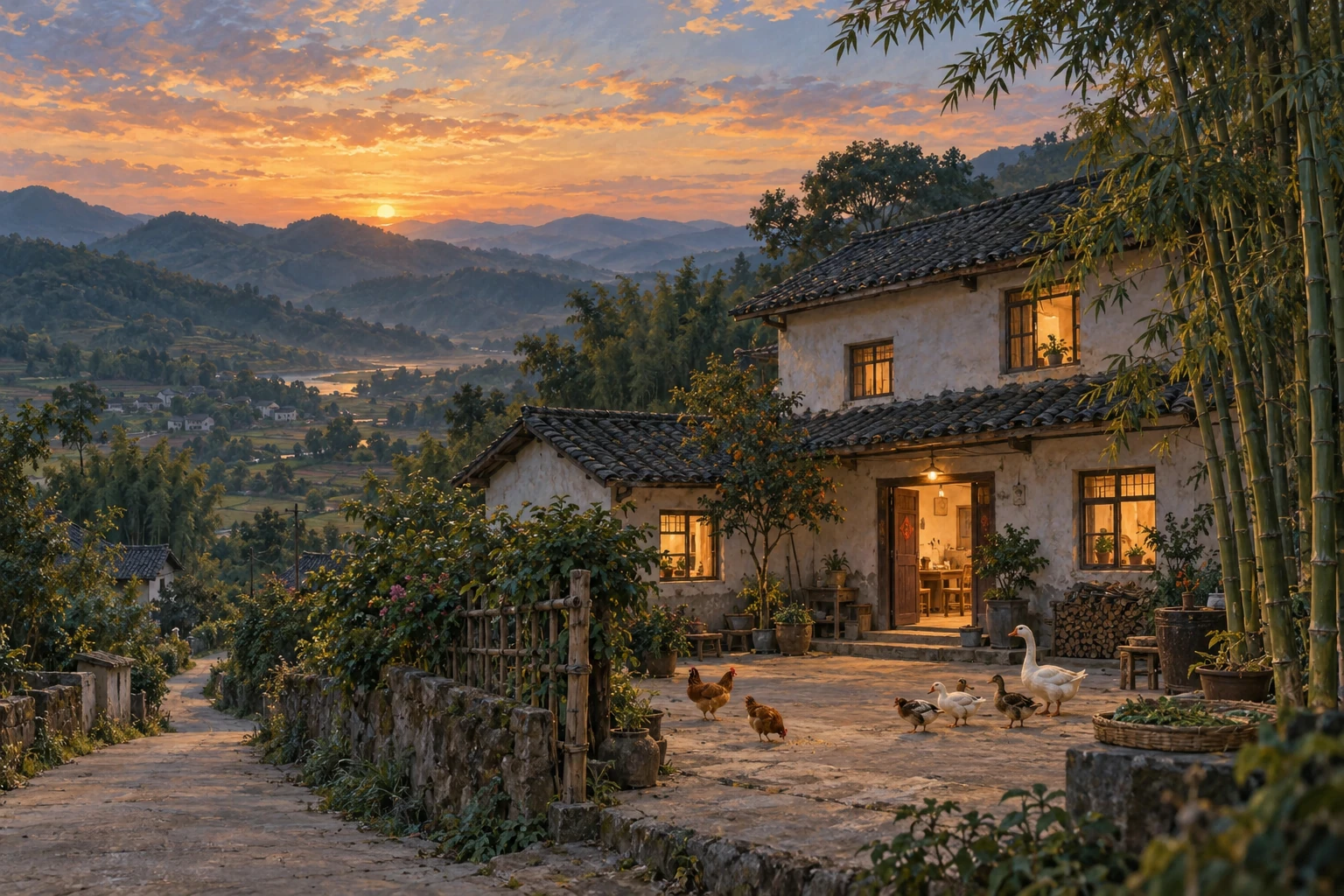
Grandma and my aunts used to live in town. Later, when it became possible to renovate the house in the countryside, they went back and rebuilt the old family home. These days, it could almost pass for a “grand villa”.
I did see the original old house when I was little.
Although I never actually lived in it, just seeing the house and its surroundings gave me a sense of how hard life must have been. Looking back, there is even something of My Thatched Cottage Wrecked by the Autumn Wind about it. Of course, simply standing nearby and looking at it offered another kind of feeling. Especially at Lunar New Year, when red scraps from spent firecrackers covered the ground, that old house in the hills had a particular beauty against the scene.
But finding a place evocative to look at and actually living there are two entirely different things.
I find it hard to imagine what it would have felt like to live for years in the conditions of those days.
That was where Dad and his siblings grew up, day by day.
Looking back now, I have a better sense of how much it took for their generation to get where they are today. So many things we now take for granted simply did not exist in their childhood. To make their way out of those circumstances, go to school, work, build families, and give the next generation an entirely different life was already a remarkable achievement.
Life at home has improved enormously, but my aunts still work very hard.
My eldest aunt leaves early and gets home late, farming, doing all sorts of jobs, and feeding the chickens, ducks, geese, and dogs. There always seems to be more to do. My second aunt spends each day at her small pharmacy, seeing people from the surrounding area when they are ill.
Country life is nowhere near as leisurely as people looking in from outside might imagine.
Yet they have always struck me as optimistic. They get on with whatever needs doing each day and rarely complain when things go wrong. When we sit together, there is still plenty of talk and laughter. Life may not be easy, but that does not seem to stop them from finding pleasure in it.
There is something there I could learn from.
This time, Feifei drove us home from Chengdu. After almost four hours on the road, we finally arrived.
I do not see my relatives very often; sometimes two or three years pass between visits. Strangely, though, there is no sense of distance when we meet. Perhaps that is how family works. You do not have to speak every day to sit down at the same table again as naturally as ever, as though all the days apart had never happened.
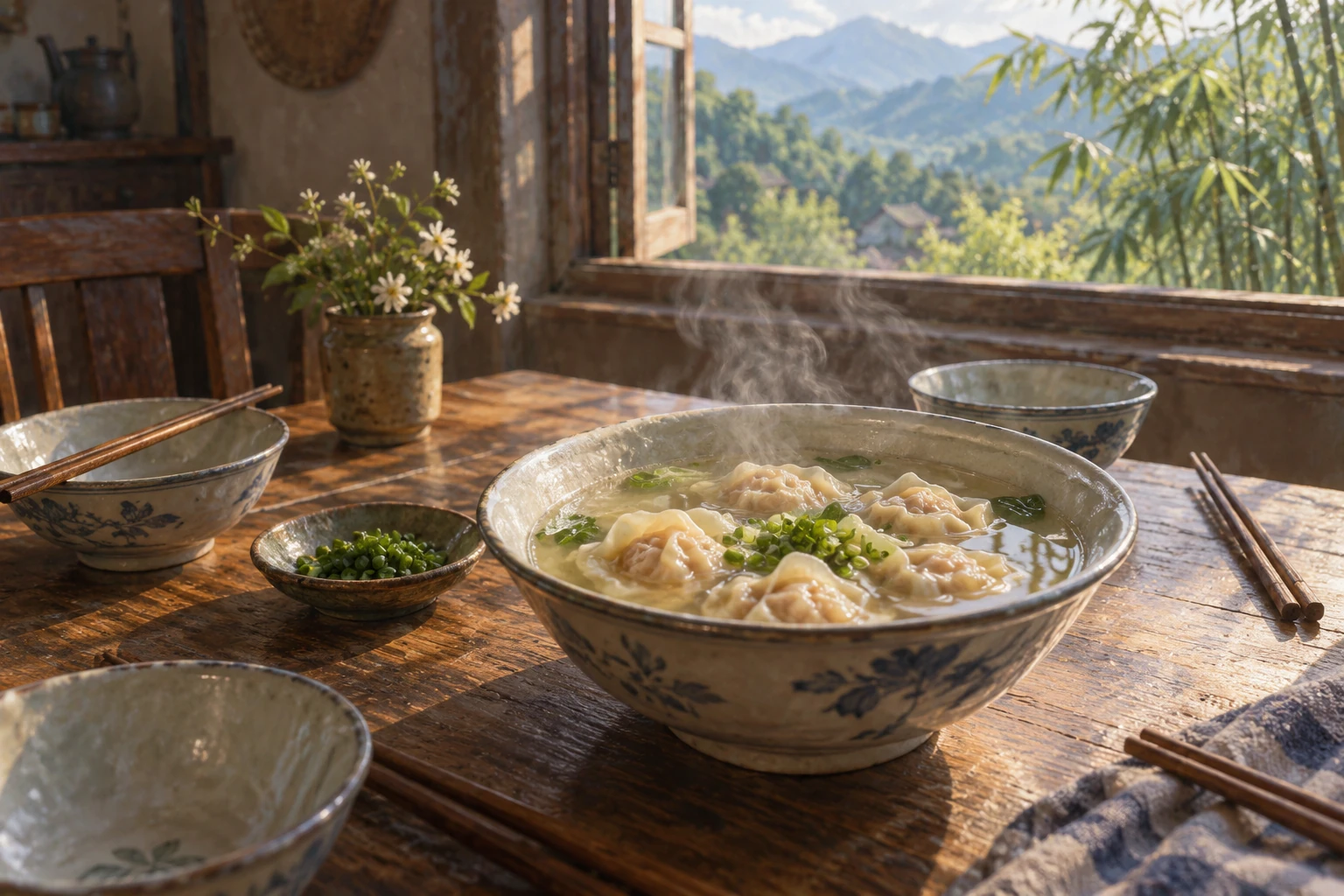
As soon as we arrived, there were freshly wrapped baomian on the table, made by my aunt.
In many parts of Sichuan, wontons are called baomian. My aunt’s have a character all their own. Even now, I cannot quite explain what makes them different, but I have never tasted anything exactly like them in a restaurant.
Once everyone knew I liked lamb steamed with seasoned rice flour, konjac, and rice tofu, they made plenty of those for me too.
The konjac in Shiqiao, in particular, really does taste different from what I usually eat elsewhere. Perhaps food is never only about ingredients and technique. It is bound up with a place, its land and water, and our memories. Many of the flavours of home are difficult to recreate once you leave.
And I really do love Dazhou’s dengying beef.
Fragrant and spicy, it is the sort of thing you keep reaching for. If anyone who loves food happens to read this and later passes through Dazhou, give it a try. If one more person ends up loving dengying beef because of this article, I will have done my tiny bit to spread the word about a speciality from home.
We did not make any elaborate plans for those few days.
We ate and drank at home, sat around talking, and occasionally went for a walk nearby.
I found myself enjoying that more than anything.
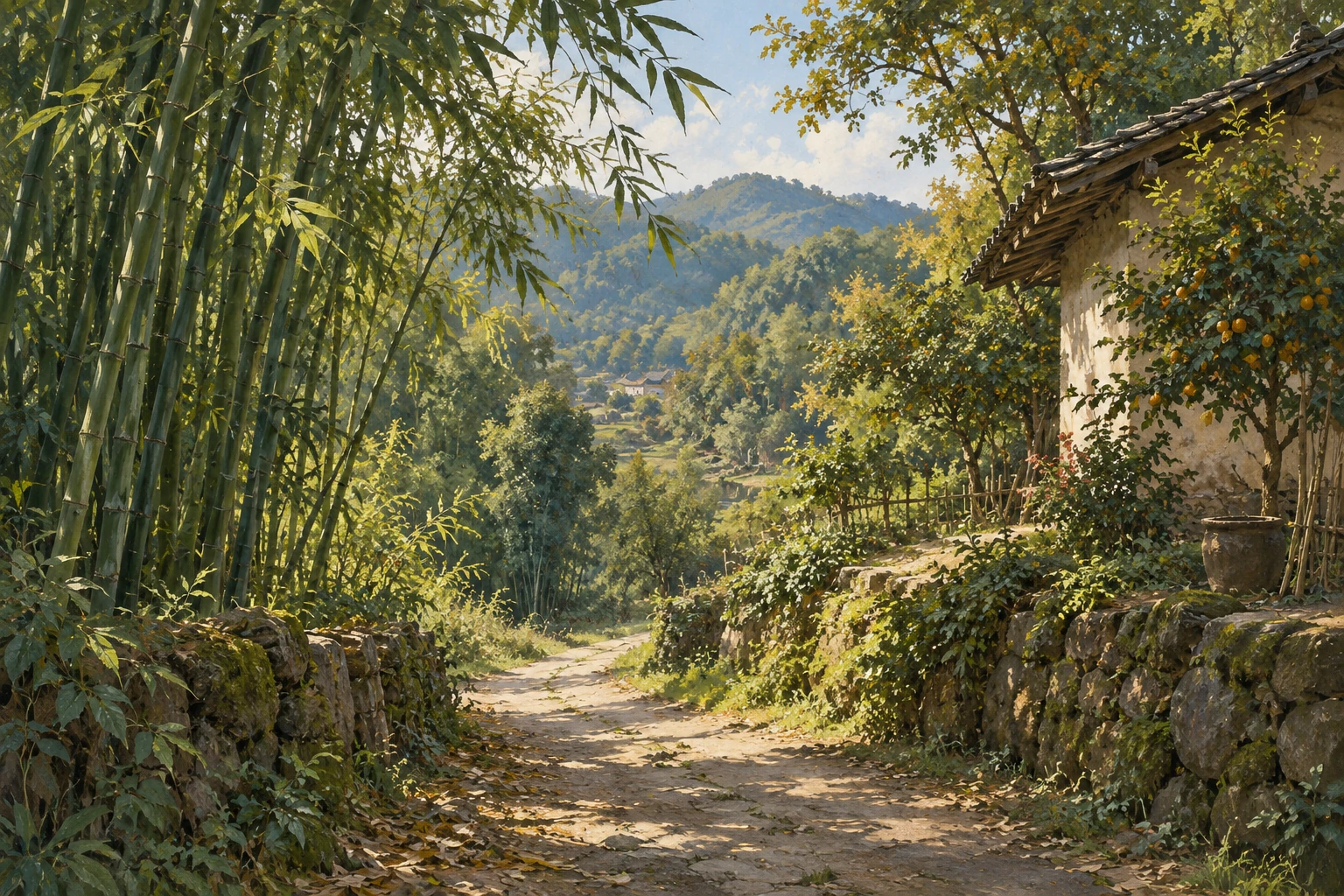
The hills begin right outside the door. There are bamboo groves and woods nearby, and you can wander along a little path with quiet all around you. No entrance gates, no sightseeing shuttles, no queues of people waiting to take the same photograph. When the wind moves through the bamboo, all you hear is the rustle of leaves.
I have always thought that people easily overlook the beauty of a place until someone packages it as a “scenic attraction”.
But if all you want is to look at the hills, the trees, and the sky, and be still for a while, this place is every bit as good as many of those designated attractions.
Above all, it is peaceful.
On the evening before I left, we all drank quite a bit.
Perhaps I really had had a little too much. Or perhaps, as the saying goes, it was not the wine making me drunk, but my own feelings. Knowing that, once I left, I could not say when we would all meet again made it hard to say goodbye.
Still, there is a consolation: I will probably become something of a “man of leisure”.
At least I should have more freedom over my time than before. That ought to let me come back more often, rather than always letting two or three years slip by between visits.
After the drinks, I found myself missing Grandpa again.
Grandpa died far too soon, and I have always felt sad about that. He was a very good person. But so much time has passed, and I was so young then, that many of my memories of him have grown hazy.
There is one scene, though, that I still remember with extraordinary clarity.
Grandpa practised traditional Chinese medicine.
I loved dinosaurs as a child. Once, he showed me some longgu, or “dragon bone”, from his medicinal supplies and told me, with a perfectly straight face, that it was dinosaur bone.
I was beside myself with excitement.
For a dinosaur-loving child, it was almost unimaginable: here I was, seeing a “dinosaur fossil” up close, and even getting to touch it.
Of course, I know now that Grandpa was teasing me.
After all these years, I can no longer remember so much about him. Yet this tiny, ordinary moment has stayed with me.
When it comes to traditional Chinese medicine, Dad and I see things in much the same way.
Although Grandpa practised it himself, I have always been sceptical of many of its theories and treatments. I put more trust in things that can be tested using modern medical methods, withstand clinical trials, and yield results that others can reproduce. How much of a traditional treatment’s effect is real, how much comes from a placebo effect, and whether it has side effects should, I think, all be subject to the same rigorous scrutiny. “We have used it for years” cannot, by itself, settle those questions.
At the same time, I am reluctant to dismiss everything under the heading of traditional Chinese medicine.
There may well be effective medicines, formulations, and practical knowledge within that tradition. The task is to identify what truly works, then test, explain, and standardise it through modern science, rather than discussing the effective and ineffective parts as though they were all the same.
At the very least, in the Shiqiao of those days, Grandpa treated a great many people and helped a great many of them.
For the people he helped, which medical system “Dr Yan” belonged to may not have mattered very much. What they remembered was that this person had been there for them when they were suffering.
And to me, before anything else, he was simply my grandpa.
The man who held up a piece of “dragon bone”, told a little boy it had come from a dinosaur, and watched him stay delighted for ages.
Time passes so quickly.
It felt as though I had only just arrived, and already it was time to leave.
In the end, Feifei drove me to Chengdu Airport too, another four hours on the road. An eight-hour round trip is a lot to ask of someone. I am truly grateful to him.
As the car travelled out of the hills towards Chengdu, the view beyond the window changed little by little.
And that was how this trip to Sichuan came to an end.
Looking back, nothing especially momentous happened. Earlier, I had visited Chengdu, Mount Qingcheng, and Dujiangyan with Mum and Dad. Then we went to Jiuzhaigou, and finally back to Shiqiao, where we ate, drank, and talked with family.
But perhaps it is precisely these ordinary things that are worth writing down.
As we grow older, we go to many places, see many landscapes, and meet many people. Yet there are always a few places that do not have to be particularly beautiful, or offer any special story. The moment you return, you know they are different from everywhere else.
I hope I can come back more often.
And I hope that next time, my aunt’s baomian will still be on the table, the chickens, ducks, and geese will still be roaming the courtyard, and we will all be sitting together, talking just as we are now.
May everyone at home stay safe and well.
At the end of this journey through Sichuan, that is my simplest wish, and the one I mean most.
把平时的经历及所思所悟记录下来,是一个很好的习惯,坚持下去,待到若干年后会成为珍贵的记忆,也会很有意思。