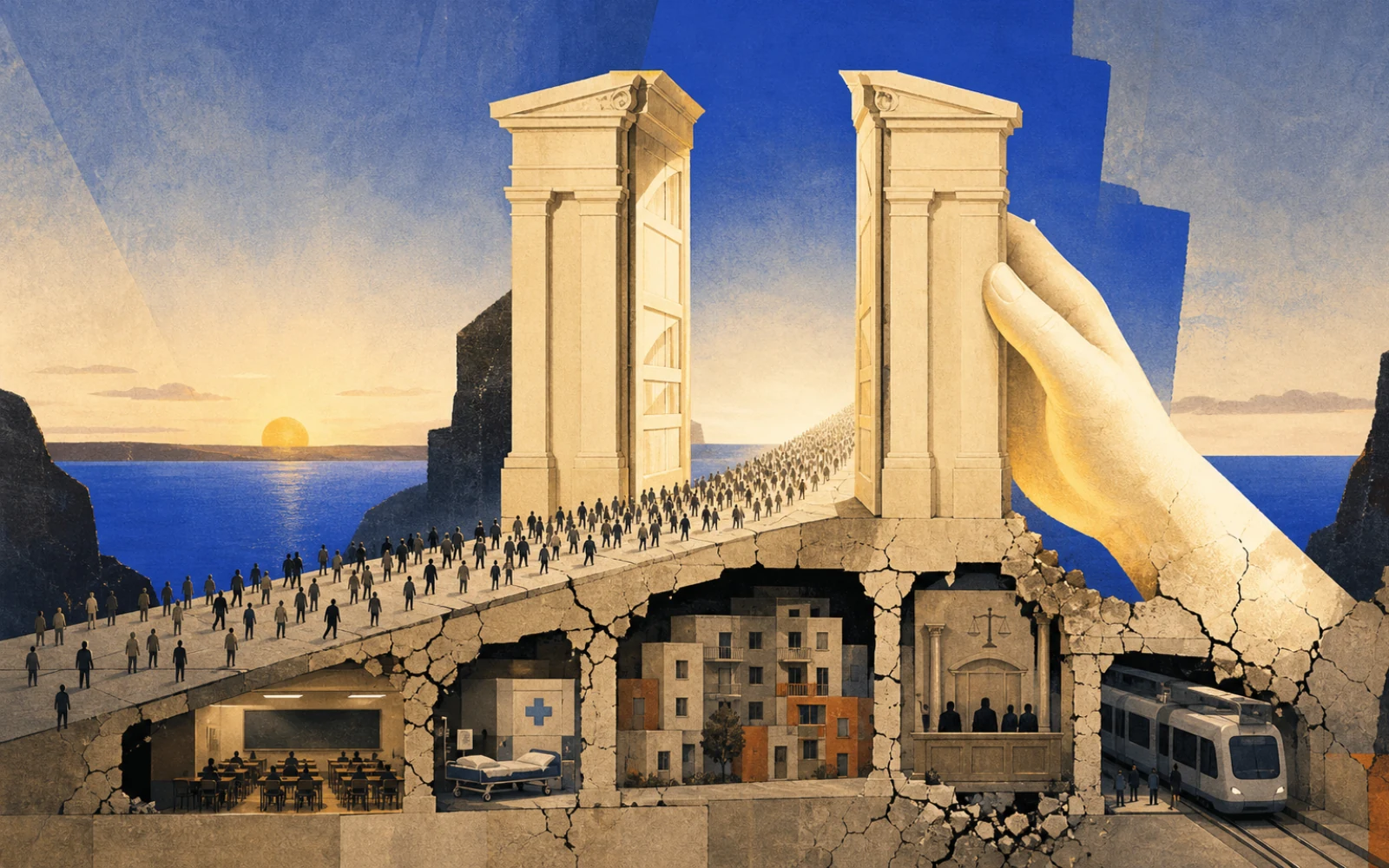
The essay argues that humanitarian policy should distinguish refugees, asylum seekers and economic migrants, while accounting for border control, public safety, fiscal capacity and integration. The author supports rules-based globalisation and lawful migration, arguing that protecting minorities and enforcing the law must go together. The essay also cautions against treating statistical associations as evidence of individual guilt.
The images from the border of Ceuta, Spain’s North African territory, have once again swept across the internet.
A note on terms: this essay discusses unauthorised border crossings and their policy consequences. “Illegal entry” describes a method of entry; it does not prejudge the outcome of any individual asylum claim or a person’s eventual legal status. This is an opinion essay. Statistical association is neither individual guilt nor proof of a single cause.
Between 30 and 31 July 2026, an estimated 50,000 to 60,000 people entered Ceuta from the Moroccan side in a remarkably short period—close to 70 per cent of the city’s resident population. Public footage and reporting showed that the arrivals were predominantly young men. By 1 August, the Spanish government had confirmed at least 67 deaths during the crossing, while roughly 48,300 people had subsequently returned to Morocco.[1][2][3]
This was not simply a group of war refugees who happened to arrive at a border. Spanish officials and media reports pointed to a combination of youth unemployment and economic hardship in Morocco, false social-media claims that the border was open and that entering Ceuta would confer legal status, misinterpretation of a Spanish Supreme Court ruling, and encouragement by smuggling networks.[1][2]
When I saw those scenes, I found it impossible to accept an overly simple narrative in which everyone who crosses a border can, without distinction, be presented as a “refugee” fleeing war and persecution.
Reality is plainly more complicated.
“Refugee” is a term with a defined legal meaning. At the heart of the 1951 Refugee Convention is a person outside their country who, owing to a well-founded fear of persecution for reasons of race, religion, nationality, membership of a particular social group, or political opinion, is unable or unwilling to obtain that country’s protection. Armed conflict, serious violence, and grave public disorder may also trigger protection under the applicable international, regional, or subsidiary-protection framework. Poverty, unemployment, and the hope of earning a higher income may be real and painful hardships, but they do not automatically establish refugee status.[4]
That is not cruelty. It is a prerequisite for any public policy to exist at all.
If poverty by itself created a right to enter a wealthier country without permission and remain there indefinitely, then billions of people whose incomes fall below the European average could, in theory, demand that Europe open its borders to them.
Every society has finite housing, schools, hospitals, policing, and fiscal capacity. Pretending these resources have no limit does not make humanitarianism nobler. It merely ensures that everyone will eventually share the cost of institutional failure.
When “humanitarianism” no longer distinguishes war refugees, asylum seekers, and economic migrants; lawful admission and illegal entry; or the costs to security, public finances, housing, and cultural integration, it ceases to be a sustainable public policy. It becomes something closer to a moral performance that refuses to discuss consequences.
I Support Globalisation—but Not Globalisation Without Rules
Before going further, I want to make my own position clear.
I am not opposed to globalisation. Quite the opposite: I have always been drawn to the ideal of being a citizen of the world.
I hope to live in different countries and cities in the future—to work, invest, and travel wherever I feel at home. Los Angeles, Copenhagen, Dubai, Shanghai, Singapore, or whichever city suits a particular stage of life: I want that freedom of choice.
I believe talent, capital, technology, and ideas should move across borders. I also believe contact among civilisations can advance society. An open and interconnected world is plainly more dynamic than one divided into hostile, sealed compartments.
But the globalisation I support must rest on the rule of law, contracts, and mutual respect.
Healthy mobility should welcome people who enter through lawful processes, obey local laws, respect the society around them, and are prepared to work, pay taxes, and create value.
A person’s skin colour, nationality, or birthplace should not determine their opportunity. Anyone with ability who is willing to follow the rules deserves fair treatment.
But illegal entry and legal immigration have never been the same thing.
Globalisation does not mean abolishing borders, selection, or responsibility. A country’s willingness to receive immigrants does not oblige it to surrender its frontier. Its willingness to protect genuine refugees does not mean that anyone who succeeds in getting across should automatically receive residence, housing, welfare, and eventually legal status.
What I oppose is not immigration itself. It is large-scale illegal migration that is disorderly, uncontrolled, unscreened, and unsupported by the capacity to integrate those who arrive.
The Security and Integration Problems Hidden by Political Correctness
Among the questions that large-scale migration cannot be allowed to evade are social integration and public safety.
When a country receives, over a short period, a large population disproportionately composed of young men with limited economic means, major language barriers, and very different cultural backgrounds—without adequate identity checks, housing, jobs, integration capacity, or law-enforcement resources—the risk of crime and social conflict will naturally rise.
Dismissing every such concern as “prejudice” does not make the risk disappear.
In 2018, Swedish public broadcaster SVT examined 843 men convicted by district courts of rape or attempted rape between 2012 and 2017. It found that 490—about 58 per cent—were born abroad.
Among “attack rape” cases in which victim and perpetrator had not previously known each other, 110 of 129 convicted offenders were born outside Sweden, including 97 born outside Europe.[5]
A study appearing in the 2026 volume of the Journal of Interpersonal Violence analysed 4,032 people convicted of rape-related offences in Sweden between 2000 and 2020, together with 20,160 matched controls.
After adjustment for socioeconomic conditions, substance misuse, mental illness, and previous criminal behaviour, the association between immigrant background and rape conviction was reduced but did not disappear. It was especially pronounced among people born outside Sweden who arrived after the age of 15.[6]
Age, poverty, education, drugs, residential segregation, and difficulty finding work can all affect crime rates. But culture should not be artificially excluded from the range of possible explanations.
Societies differ substantially in their understanding of women’s status, sexual consent, personal freedom, family honour, and religious authority. Attitudes formed in a highly conservative environment marked by strict gender separation and powerful family authority do not vanish the moment someone crosses a European border.
Culture does not determine the conduct of every individual. But it can shape how groups understand women, law, violence, and personal boundaries. Refusing to examine that possibility is not science; it is ideology.
Germany’s figures are equally stark.
Germany’s 2025 police crime statistics reported that non-German citizens accounted for 38.5 per cent of suspects in rape, sexual coercion, and aggravated sexual-assault offences, and 42.9 per cent of suspects in violent crime. Foreign citizens made up roughly 14.9 per cent of Germany’s resident population over the same period.[7][8]
“Non-German” is not synonymous with “illegal immigrant”, and a suspect is not a convicted offender. The police numerator can also include tourists, people in transit, and other non-residents who are absent from the resident-population denominator. Differences in age and sex composition materially affect a direct comparison. These percentages are therefore not an adjusted estimate of any individual’s offending risk.
Even so, when a group representing about 15 per cent of the resident population accounts for nearly 40 per cent of suspects in relevant categories, the disparity cannot simply be waved away with the claim that “statistics prove nothing”.
Statistics require explanation, not cancellation.
The responsible response to uncomfortable data is to determine where the overrepresentation comes from: how much is due to age and sex composition, how much to poverty and unemployment, how much to failed integration, and how much—if any—to cultural attitudes towards sex and gender in countries of origin.
The least responsible approach is to announce, before inquiry has even begun, that culture and migration patterns can have no relevance at all.
Rotherham: When Political Correctness Began Protecting Offenders
The child-sexual-exploitation scandal in Rotherham is among the ugliest consequences of European political correctness.
The official independent inquiry led by Alexis Jay estimated that at least 1,400 children were sexually exploited in the town between 1997 and 2013. Across many historic cases, victims were predominantly vulnerable white British girls; within one of the perpetrator groupings discussed in the report, most known offenders were men of Pakistani heritage.[9]
This was not a handful of hidden, isolated offences. It was sustained, systemic abuse on a staggering scale.
What makes it more enraging is that the institutions involved were not wholly unaware of what was happening.
Police, social workers, and the local authority had encountered victims and accumulated extensive evidence. Yet some staff were afraid that identifying and discussing the ethnic background of offenders would expose them to accusations of racism. Others feared that investigation would damage “community relations”; some recalled instructions not to emphasise the offenders’ ethnicity.[9]
The result was grotesque.
Adult men repeatedly raping and sexually exploiting underage girls was no longer treated as the overriding problem. Avoiding offence to the community with which the perpetrators were associated became, for parts of the system, a higher priority.
Victims reported what had happened and asked for help, only to be described as unreliable, chaotic, or even as having “consented” to their abuse.
The children who most needed protection were abandoned. The criminal networks that required investigation gained de facto shelter from ethnic sensitivity.
The most frightening part of Rotherham is not only that 1,400 children were harmed. It is that the moral priorities of public institutions had been inverted.
To preserve an image of inclusion, real victims could be met with indifference. To avoid an allegation of discrimination, recurring offending patterns could be ignored. To protect the public image of a community, the most vulnerable girls could be made to bear the cost.
That is not anti-racism.
Genuine anti-racism means equal treatment under law: neither presuming guilt because of ethnicity nor being afraid to investigate because of it.
Rotherham produced the opposite. Because some perpetrators belonged to a minority community, parts of the public system lowered the ordinary standard of investigation and accountability. Political correctness did not protect minorities or advance integration. It shielded offenders and destroyed public confidence in institutions.
When a society must repeatedly censor itself merely to describe who committed a crime, it will struggle to solve the crime.
Henry Nowak: How Could One Allegation of Racism Outrank the Evidence at the Scene?
The killing of Henry Nowak in Southampton in December 2025 exposes a related institutional logic.
This was not a crime committed by an illegal immigrant. Vickrum Singh Digwa, who killed Nowak, was born and raised in Britain. I include the case because it raises a deeper question: when public institutions become excessively afraid of accusations of racism or religious discrimination, can they still judge evidence before identity narratives?
Nowak was 18 and in his first year at the University of Southampton.
On the evening of 3 December 2025, he was walking alone back to his accommodation when he encountered Digwa, then 22. Nowak was unarmed. Along with the smaller kirpan he normally wore, Digwa carried a much larger sheathed Sikh dagger over the outside of his clothes.
After a brief confrontation, Digwa drew the dagger and stabbed Nowak in the chest, twice in the upper leg, and once in the lower abdomen or groin, as well as slashing his face. The fatal thrust passed between the upper ribs, caught a lung, and severed an important vein behind the collarbone.[10]
After the attack, Digwa did not tell police that he had used a knife. He falsely claimed that Nowak had attacked him and racially abused him. He instructed his mother to remove the murder weapon, sheath, and belt, while he and members of his family supplied police with a false account.
When officers arrived, they initially accepted the Digwa side’s account of a racist attack.
Although gravely wounded, Nowak repeatedly said he had been stabbed and could not breathe. Officers nevertheless announced his arrest and placed him in handcuffs. About a minute later, as his condition rapidly deteriorated, they removed the cuffs and began CPR.[10]
A man with a penetrating chest wound, blood on his face, and severe difficulty breathing was first restrained as a suspect. The person who carried the large blade and carried out the stabbing acquired the initial advantage of credibility through a false allegation of racism.
The scene is disturbing enough on its own.
But the full context must also be stated. The sentencing judge said officers had been given a “convincing but wholly false narrative”. It was dark; Nowak wore a dark top; and the fatal chest wound was not obvious. The officers had to make rapid decisions under pressure. In the judge’s view, they honestly believed there were reasonable grounds to arrest Nowak and began CPR when they recognised his deterioration.[10]
That context does not make the handcuffing or delay uncontroversial. It does mean that “identity bias caused the mistake” remains a hypothesis under investigation, not a fact already found by a court.
The Independent Office for Police Conduct later announced that the first two officers at the scene were under investigation for potential gross misconduct. The investigation covers their possible failure to recognise Nowak’s urgent medical need, the decision to arrest and handcuff him, the first aid provided, and whether race or religion influenced decision-making. The IOPC also stressed that serving gross-misconduct notices does not mean disciplinary proceedings will necessarily follow.[11]
Whatever the investigation ultimately concludes about individual responsibility, the case leaves an unavoidable question:
Why can the words “I am the victim of racism” acquire such priority before the evidence has been established?
Anti-discrimination should not mean presuming that a minority individual is the victim or that a majority individual is the aggressor.
The first questions for police should concern weapons, injuries, conduct at the scene, and contradictions among accounts—not who first uttered the word “racism”.
Equality means subjecting everyone’s statement to the same evidential test and everyone’s conduct to the same legal consequences. Otherwise, anti-discrimination ceases to remove prejudice and becomes a new form of discrimination that allocates credibility, responsibility, and privilege by identity.
Privilege Is Not Equality; It Is Another Form of Discrimination
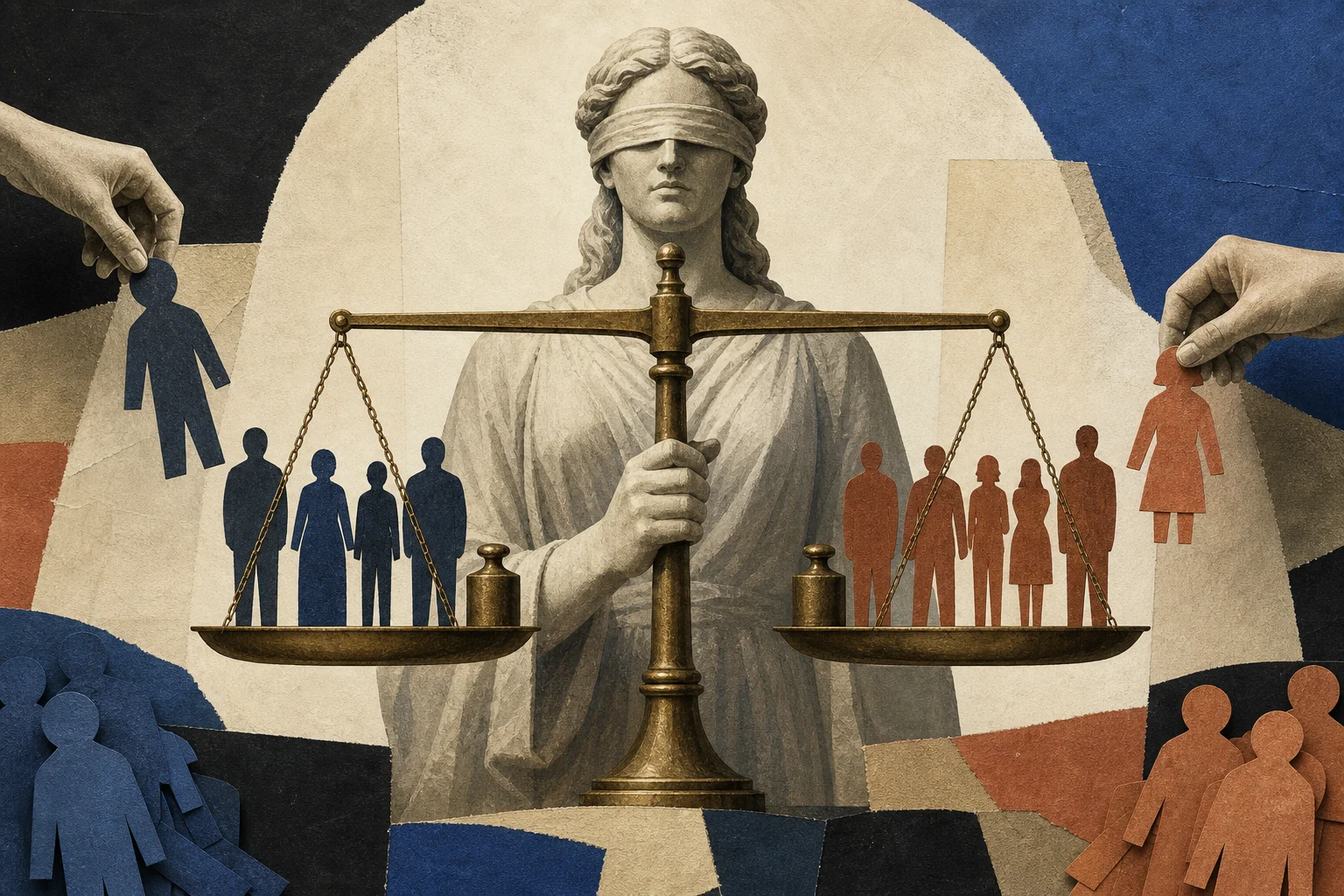
Beneath all this lies a more fundamental problem. For parts of the progressive movement, “anti-discrimination” no longer means equality before the law. It means assigning different degrees of protection, tolerance, and credibility according to group identity.
In this narrative, minorities are inherently more vulnerable and therefore require special treatment, while majorities are presumed to possess power and are expected to tolerate greater suspicion, constraint, and even unfairness.
It sounds like protection of the weak. In practice, it remains identity-based discrimination.
Traditional prejudice placed minorities below others. This newer political correctness first claims the moral high ground and then imagines minority adults as people who can never independently bear responsibility—people who must be protected and indulged by enlightened elites.
It appears benevolent, but underneath lies a condescending arrogance.
The unspoken message is:
“I do not believe you can live by the same standards as I do, so I am willing to lower them for you.”
That is not respect. It is contempt wrapped in kindness.
An adult who breaks the law should answer for the conduct—not be excused because of ethnicity, religion, or migration background on the grounds that they “do not understand local rules”, come from a disadvantaged environment, or deserve greater indulgence.
A member of a minority who makes an allegation should face the same factual scrutiny as anyone else, not acquire extra credibility because the allegation fits a preferred victim narrative.
To respect a group is not to treat its members as children in permanent need of protection. It is to recognise that, like everyone else, they possess reason, free will, and the capacity to take responsibility for what they do.
A society contradicts itself if it proclaims one group wholly equal while simultaneously insisting that its members cannot bear the same legal standards, social duties, or criticism as everyone else.
Nor should injustice in the present be used to compensate for injustice in the past.
The historical oppression of some minority groups does not entitle a particular person today to priority in law, public debate, or public resources.
An ordinary person born today should not inherit guilt for history they did not make merely because they belong to a supposed majority. Nor should a minority individual receive moral immunity merely by virtue of identity.
Historical injustice should be addressed by improving institutions, fighting discrimination that still exists, and protecting equality of opportunity—not by creating a new hierarchy with the direction reversed.
The heart of non-discrimination is not privilege. It is equal citizenship.
The same conduct, under the same law.
The same allegation, under the same evidential scrutiny.
The same rights, accompanied by the same responsibilities.
Neither belittle nor indulge a person because of ethnicity. Do not presume guilt because someone belongs to a majority, or innocence because someone belongs to a minority.
That is equality.
When “anti-discrimination” demands different legal treatment according to identity—when minority status becomes grounds for exemption, preferential credibility, or a lower standard of responsibility—it has betrayed the original meaning of equality.
It is no longer dismantling identity hierarchies. It is building a new one in the opposite direction.
Why Can an Ordinary Person Not Carry Pepper Spray While a Religious Believer Can Carry a Dagger?
The Henry Nowak case also exposes a contradiction in British weapons law that is difficult to reconcile.
Britain is a country in which an ordinary person cannot carry pepper spray for self-defence. Personal-protection sprays that discharge CS, Mace, or OC pepper are treated as prohibited weapons. Even a woman who fears rape or robbery while walking alone at night cannot lawfully carry one for that reason.[12]
At the same time, British law recognises that “religious reasons” may amount to a good reason for carrying a blade in public. The best-known example is the kirpan carried by some Sikhs. Whether that reason succeeds in a particular case is ultimately for a court to decide.[13][14]
This does not mean that Sikhs may use knives to attack people. Once any blade is used to threaten or assault, a religious reason cannot protect the conduct.
But it does not answer the underlying question:
Why may an ordinary woman with no criminal record not carry a comparatively less lethal defence spray, while a religious believer may invoke tradition to carry in public a sharp object capable of killing within seconds?
An object does not become less dangerous because it carries centuries of history and religious meaning.
I respect a believer’s right to understand the kirpan as a symbol of courage, duty, and protection of the weak. That symbolic understanding does not contradict the physical fact that a sharp blade can penetrate a chest and sever a blood vessel.
This invites a simple thought experiment.
Suppose I declared tomorrow that I had founded a small religion in which a firearm was an indispensable sacred object. Would the British government then have to let me carry a handgun on the streets of London?
Obviously not.
Freedom of religion protects belief. It does not create an unlimited right to perform any act in religion’s name. Britain’s human-rights framework expressly permits lawful, necessary, and proportionate restrictions on religious manifestation in the interests of public safety, public order, and the rights of others.[15]
The question, then, is not whether religious freedom should exist. It is why British law appears to apply inconsistent standards of risk to religious practice and to ordinary people’s desire for self-defence.
I do not believe every form of kirpan must be banned.
A small symbolic kirpan with a blunted blade, secured inside its sheath and not readily drawn, is plainly different from a large, sharp dagger worn externally and immediately available for use.
A more coherent regime would draw lines according to objective risk rather than religious identity: limiting blade length, requiring secure enclosure, prohibiting open display, and not allowing multiple combat-capable blades to be carried at once.
Religious belief deserves respect. Public safety should not be allocated according to the age of a religious tradition.
If a country prohibits an ordinary person from carrying pepper spray while allowing some people to carry a more lethal blade for religious reasons, it owes the public an explanation of the consistent risk principle behind the distinction. “The tradition is older, more sensitive, and harder for politicians to question” is not an adequate answer.
Official Statistics Cannot Explain Away Everything People Experience
Whenever migration and crime are discussed, someone produces an official dataset and tells the public that the deterioration they perceive does not exist.
But official statistics have never captured every crime that occurred.
For a theft, robbery, or harassment case to appear in conviction data, the victim must report it; police must record it, identify a suspect, and gather evidence; prosecutors must bring a charge; and a court must convict.
If the process breaks at any point, the final conviction figures retain no trace of the event.
During my time in Britain, both I and people around me experienced theft and street robbery. Often, reporting the incident produced little more than a crime-reference number and no meaningful progress afterwards.
No suspect was found. No prosecution followed. No conviction occurred.
If someone commits ten thefts and is never caught, the conviction statistics still record zero. If victims conclude that reporting is pointless and stay silent, the incidents may never enter police-recorded crime at all.
Personal experience cannot replace national statistics. But statistics cannot replace lived reality either.
Unsolved and unprosecuted theft, street harassment, violent threats, and antisocial behaviour still erode quality of life, security, and trust among neighbours.
Eurostat reported that EU police recorded 256,302 sexual-violence offences in 2024, including 98,190 recorded rapes. Compared with 2014, recorded sexual-violence offences rose by about 94 per cent and rape offences by about 150 per cent.[16]
Greater willingness to report, broader legal definitions, and changes in police recording can certainly explain part of the increase. Eurostat itself notes that greater social awareness can affect reporting rates. But “more people are reporting now” is not, by itself, a complete explanation of every change.
These figures do not prove that immigration caused the entire increase. They do justify asking what roles may have been played by demographic structure, the proportion of young men, cultural norms in countries of origin, and failures of integration.
Reason is not the prohibition of causal questions. It is the willingness to test every plausible explanation.
The Deepest Injustice to Legal Immigrants
One of the greatest absurdities of failed illegal-migration policy is that it ultimately punishes the people who obey the rules.
Legal immigrants apply for visas, pay fees, prove their education, employability, finances, or family ties. They may spend years learning a language, waiting for a quota, and undergoing background checks before they can enter and remain lawfully.
Others need only cross a border and then use a prolonged asylum process, judicial appeals, and administrative delay to remain for years.
Even after an asylum claim is rejected, return may remain unenforced because identity cannot be verified, travel documents are missing, a country of origin refuses readmission, applications are repeated, or the person disappears.
In 2025, the European Commission acknowledged that return rates across the EU had long stood at only about 20 per cent.[17]
What are legal immigrants supposed to think?
One person studies, works, pays visa fees, proves financial means, and follows every procedure. Another crosses the border directly, yet may secure years of de facto residence because the state cannot execute its own return decision.
When a system gives a quicker practical result to those who break its rules than to those who observe them, it rewards non-compliance and penalises lawful behaviour.
Any serious migration system must distinguish legal immigrants, illegal border crossers, genuine refugees facing war or persecution, and economic migrants seeking higher income or more generous welfare.
If these categories are no longer distinguished, borders, visas, and immigration approval gradually lose their meaning.
More dangerously, when rule-following people discover that the rules cannot protect them, confidence in the rule of law itself is weakened.
What is damaged is not only an immigration policy, but society’s basic belief in fairness and contract.
Humanitarianism at Other People’s Expense
Many European countries operate high-tax, high-welfare systems.
These systems function because most residents work, pay taxes, and follow rules, while government uses their taxes to fund health care, education, housing, and social protection.
That is a social contract, not a supply of free resources that appears from nowhere.
Reception centres, temporary accommodation, health care, education, interpretation, legal aid, border enforcement, asylum decisions, and return procedures all require real expenditure.
Even a person who receives no direct cash benefit still uses capacity in housing, schools, hospitals, courts, and administration.
Those costs do not disappear. Taxpayers pay them, or other public services absorb them through reduced quality and availability.
I often think it is remarkably easy for parts of the European progressive class to advertise compassion, because they are not spending only their own money. They are spending society’s money.
They may live in affluent, safe, high-cost neighbourhoods and publicly welcome immigration with almost no upper limit, while avoiding the housing shortages, crowded schools, health-care queues, and policing pressures borne by ordinary communities.
The real costs often fall on working people with average incomes who cannot simply move away, yet must continue paying taxes on time.
When government requires ordinary residents to absorb ever higher costs while classifying any question as a failure of compassion, policy has ceased to be humanitarian. It has become moral coercion.
Genuine compassion should at least be willing to count the cost and answer honestly:
How many people can a country actually receive?
Where will the housing come from?
Do schools and hospitals have enough capacity?
Who will bear the fiscal cost?
When resources are necessarily finite, who should be helped first?
Refusing to answer does not remove the cost. It merely removes the voice of those who bear it.

Demographic Structure Is Not a Conspiracy Theory; It Is Arithmetic
Europe’s longstanding population has low fertility and is ageing, while some immigrant populations are younger overall and have higher average fertility.
Pew Research Center’s analysis based on 2016 data found a median age of 30.4 among European Muslims, roughly 13 years younger than the 43.8 median among other Europeans. It projected an average total fertility rate of about 2.6 for Muslim women in Europe during 2015–20, compared with 1.6 for non-Muslim women.[18]
If low fertility, sustained large-scale migration, and fertility differences among groups persist together over time, Europe’s demographic composition, the relative shares of established populations, and the cultural character of some cities and neighbourhoods will necessarily change.
That is not a conspiracy theory. It is population arithmetic.
Fertility among second- and third-generation immigrants may fall with education, income, and urbanisation. Intermarriage and changes in identity will also occur. Pew’s own projection expected the fertility gap to narrow. These factors change the pace of demographic change; they do not make demographic change cease to exist.
The relevant question is not whether Europe must preserve some eternal bloodline. It is whether the speed of change remains within a society’s capacity to absorb it.
Can new arrivals learn the local language?
Can they enter the labour market?
Can they accept common law and basic values?
Does the state have enough housing, education, employment, and governing capacity to ensure that different communities inhabit one society rather than isolated parallel ones?
A modern society can be shared by people of many ethnic, religious, and cultural backgrounds. But common life requires some non-negotiable foundations:
Law must stand above religious rules.
Individual freedom must stand above family coercion.
Women and men must be equal before the law.
Children must have the right to education and freedom from forced marriage.
Sexual minorities must not face violence because of who they are.
These are not the local customs of one ethnicity. They are the basic public compact of a modern liberal society.
If no consensus can form around these foundations, multiculturalism will not produce flourishing. It will produce parallel societies separated by distrust.
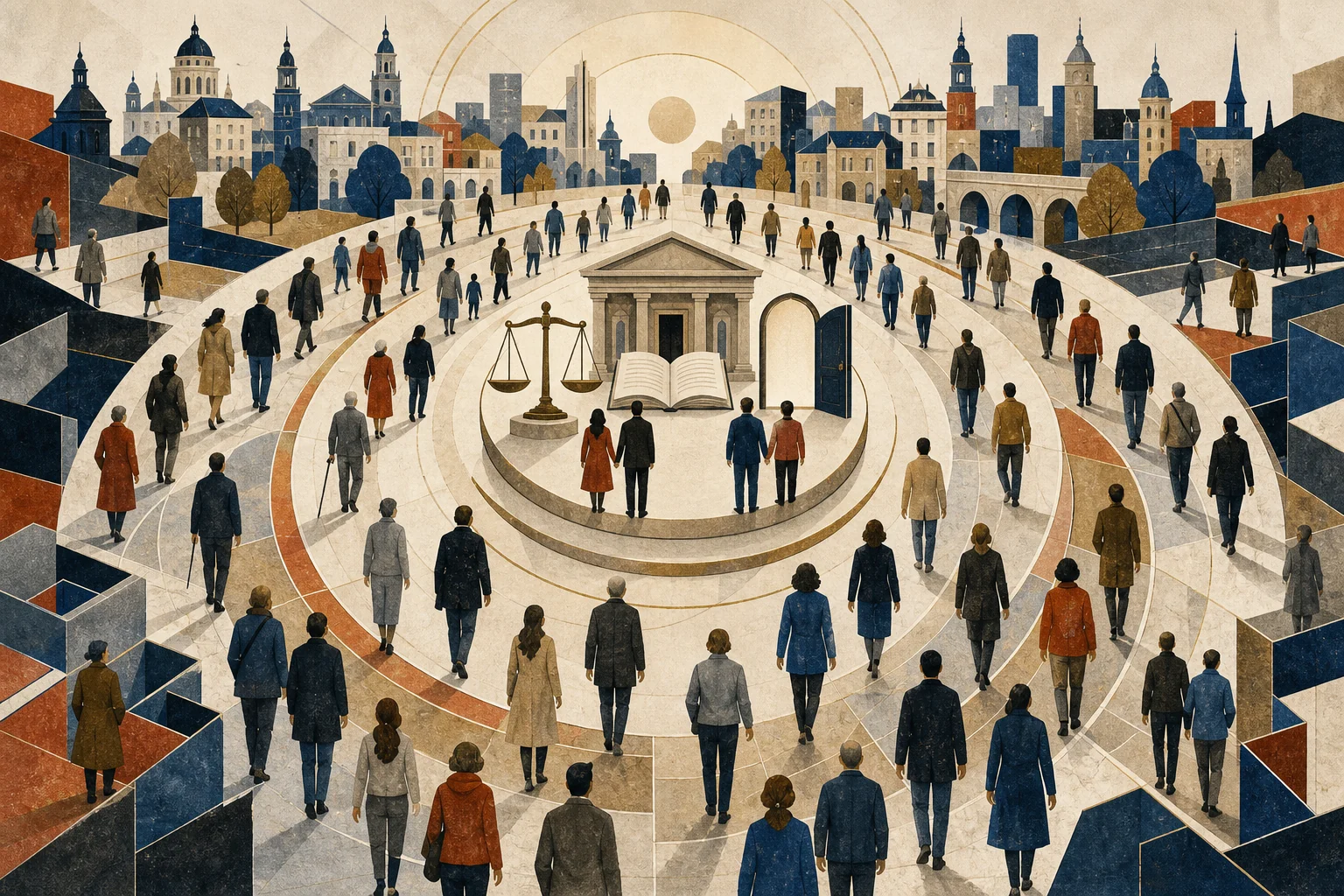
Progressivism’s Cognitive Split
What I find still harder to understand is the contradiction in the values of some European progressives.
They champion feminism and LGBTQ rights while extending almost limitless tolerance towards religious cultures that may be extremely conservative on women’s rights, freedom of marriage, and homosexuality—especially some traditions of conservative Islam.
They condemn gender inequality in traditional European society, yet when forced marriage, restrictions on girls’ education, compulsory dress, or persecution of sexual minorities are justified in the name of religion, family, or culture, they suddenly invoke “respect for cultural difference”.
Does oppression cease to be oppression when it wears religious and cultural clothing?
Respecting freedom of belief is not the same as tolerating religious conservatism that violates the fundamental rights of women, children, and sexual minorities.
A society that genuinely believes in equality between women and men, personal liberty, and LGBTQ rights must be prepared to require everyone who lives there to observe those principles.
Fear of being called discriminatory cannot justify pretending that no real conflicts exist among systems of value.
Tolerance does not mean silence about everything.
A confident liberal society should both protect minorities from discrimination and oppose, without hesitation, any oppression carried out in the name of religion, tradition, or culture.
Extending “inclusion” without limit to practices that conflict fundamentally with liberal society’s core values is not progress. It is naivety without boundaries.
Europe Is Falling Behind in the Competition That Will Define the Era
The irony is that while Europe spends immense political energy on identity, wording, regulation, and abstract moral disputes, the United States and China are competing for leadership in artificial intelligence, semiconductors, energy, robotics, and advanced manufacturing.
Stanford’s 2026 AI Index Report found that private AI investment in the United States reached $285.9 billion in 2025, compared with $12.4 billion in China. On this measure alone, the US total was more than 23 times China’s. The report also cautioned that private-investment figures may understate the scale of Chinese capital channelled through government guidance funds and industrial policy.[19]
One investment measure cannot capture the entirety of a region’s technological strength, nor reduce the capabilities of Europe’s many countries to a single financing statistic. It is nevertheless evidence that Europe no longer occupies the leading position in the technologies that will shape the next generation of productivity and state power.
This is not an argument that environmental protection, human rights, and technology regulation do not matter.
The problem is that a civilisation which becomes skilled only at restricting, reviewing, and redistributing—while losing the capacity to create new technology, industry, and wealth—will eventually lose the economic foundation required to sustain both a generous welfare state and its human-rights ideals.
Europe was the birthplace of the Industrial Revolution and the centre of modern science, finance, and manufacturing.
Today, to my mind, it is too absorbed by moral posture and self-restraint: falling behind in the technologies that will determine future power while assuming that more rules and more correct language will preserve the world’s respect.
Meanwhile, grave human-rights disasters continue: girls are denied education, children are forced into marriage, women suffer family and religious violence, and religious minorities are persecuted by extremists.
At times, these realities receive less attention than a dispute over language inside Europe.
It makes me wonder whether some people care about universal human rights at all, or primarily about whichever rights provide the most convenient material for domestic political performance.

Compassion Must Be Built on Order
I do not oppose immigration, and I do not oppose helping people who genuinely need protection.
Europe can receive screened refugees who truly face war and persecution. It should welcome legal immigrants with ability who are prepared to work, follow the rules, and integrate into society.
But any system must be limited, selective, and enforceable.
Government must at least answer a few basic questions:
Who qualifies to enter?
How many people can a country realistically receive?
Who bears the cost?
Can rejected asylum decisions actually be enforced?
Will people who commit serious crimes be removed?
Do borders and visa rules still have practical meaning?
If these questions remain unanswered, “humanitarianism” becomes a moral wrapper for the loss of border control.
I support globalisation, but not globalisation without order.
I support human mobility, but freedom must carry responsibility.
I support multiculturalism, but it cannot supersede common law and basic human rights.
I support the ideal of world citizenship, but a genuine citizen of the world begins by respecting the rules of every country—not by treating its border and welfare state as public property available to anyone who can force an entry.
If Europe continues along its present course, the long-term results are likely to include declining social trust, deeper community conflict, greater fiscal pressure, continued demographic change, and further losses in economic and technological competitiveness.
Pointing to these risks is not xenophobia.
On the contrary, only by confronting real costs honestly can Europe construct a system that protects genuine refugees, respects legal immigrants, and retains the lasting support of its own residents.
Humanitarianism should never require the collapse of order.
When it no longer distinguishes refugees from economic migrants, lawful entry from illegal entry, or counts the costs to security, public finances, culture, and demography, it is no longer genuine compassion.
It is ordinary people being asked to pay—with their safety, taxes, and future—for someone else’s moral superiority.
Reference List
All online sources were last accessed on 2 August 2026.
- Associated Press. Tens of thousands of migrants voluntarily leave after crossing into Spanish territory of Ceuta. 31 July 2026.
- Associated Press. Fact Focus: Migrant crossing in Spain’s Ceuta breeds unsubstantiated claims. 31 July 2026.
- Associated Press. Spain installs sea barrier on Ceuta’s border with Morocco after frontier rush that killed 67. 1 August 2026.
- United Nations High Commissioner for Refugees. Refugee definition; see also The 1951 Refugee Convention.
- Sveriges Television. Ny kartläggning av våldtäktsdomar: 58 procent av de dömda födda utomlands. 22 August 2018.
- Khoshnood, Ardavan M., Jan Sundquist, and Kristina Sundquist. Immigrant Background and Rape Conviction: A 21-Year Follow-Up Study in Sweden. Journal of Interpersonal Violence 41, nos. 1–2 (2026): 372–390.
- German Federal Government. Polizeiliche Kriminalstatistik 2025. 20 April 2026.
- Statistisches Bundesamt. Bevölkerung Deutschlands im 1. Quartal 2026 leicht zurückgegangen. 7 July 2026.
- Jay, Alexis. Independent Inquiry into Child Sexual Exploitation in Rotherham, 1997–2013. Rotherham Metropolitan Borough Council, 2014.
- Courts and Tribunals Judiciary. R v Vickrum Singh Digwa: Sentencing Remarks. Southampton Crown Court, 1 June 2026.
- Independent Office for Police Conduct. IOPC investigating conduct of two officers in Henry Nowak case. 1 July 2026.
- UK Home Office. Guide on firearms licensing law.
- UK Parliament. Criminal Justice Act 1988, Section 139.
- UK Government. Selling, buying and carrying knives and weapons.
- Equality and Human Rights Commission. Article 9: Freedom of thought, belief and religion.
- Eurostat. EU sexual violence and rape offences up in last 10 years. 29 April 2026.
- European Commission. Commission proposes a new Common European System for Returns. 11 March 2025.
- Pew Research Center. Europe’s Growing Muslim Population. 29 November 2017.
- Stanford Institute for Human-Centered Artificial Intelligence. The 2026 AI Index Report: Economy. Stanford University, 2026.



ABOUT THIS ESSAY
Leave a thought. 00
Discussing: Europe’s Borders and the Measure of Compassion
Different perspectives are welcome. Be kind. Both language versions of this essay share this conversation.
No published comments yet. Your thought could be the beginning of a conversation.